Imagine organizing a neighborhood effort to clean up a local park. Everyone benefits from a cleaner, safer space, but no single person can do the work alone. That tension captures the basic problem of collective action: a shared goal depends on many people deciding that joining is worth their time, effort, or risk. This article uses that simple example to explain why some public priorities gain momentum while others stall.

Why this matters
This article makes a simple argument: adoption is often a bigger obstacle than agreement. Large-scale priorities advance when people see them as credible, useful, and worth joining—and when networks, resources, and public narratives make participation easier rather than riskier. The sections below focus on the core theory and its implications in practice.

The operational concept combines five ideas. First, collective action theory explains why people hesitate when benefits are shared but costs are immediate or uneven (Kapucu & Beaudet, 2020). Second, diffusion theory shows that adoption spreads faster when a priority appears useful, compatible with existing values, and easy to observe in practice (Educational Technology, n.d.; van den Broek & Klingler-Vidra, 2022). Third, threshold models explain why momentum often depends on early visible commitments from influential actors (Granovetter, 1978). Fourth, cascade theory shows how networks can rapidly accelerate imitation—but also misinformation or symbolic compliance (Cong & Xiao, 2023). Fifth, framing theory explains why narrative matters: people mobilize around meaning, not facts alone (Dick, 2013; Snow & Benford, n.d.).
A simple unified theory of why adoption varies
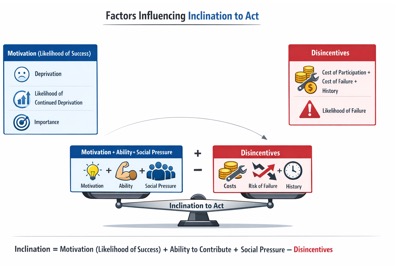
Together, these perspectives suggest that adoption rises when incentives align, trusted actors move first, networks transmit credibility, and public narratives make participation feel legitimate and urgent. It slows when costs are concentrated, institutions are weak, or the issue is framed as abstract, threatening, or politically divisive (Kapucu & Beaudet, 2020; Educational Technology, n.d.; Granovetter, 1978; Cong & Xiao, 2023).
In practical terms, this means policy success depends not only on design quality but on timing, coalition-building, communication, and follow-through. Visible early wins can create momentum; backlash, mistrust, and poor implementation can raise participation thresholds and stall progress (Granovetter, 1978; Modern Diplomacy, 2024).
What this means in practice
For policymakers, advocates, and institutions, the practical implication is straightforward: adoption improves when the path to participation is visible, socially validated, and operationally supported.
People are more likely to join when a priority feels workable, credible, and already in motion.
The main risks are equally clear: financing gaps, weak institutions, misinformation, and backlash can all interrupt adoption even when broad agreement exists.
Bottom line
The central insight is that ambitious priorities do not spread on evidence alone. They spread when institutions solve coordination problems, reduce risk, build trust, and make participation visible.
If leaders want faster adoption, they should focus less on announcing goals and more on creating momentum: align incentives, recruit trusted messengers, support early adopters, and turn small wins into public proof that change is possible.
In the end, building a collective effort means turning a small core of committed participants into a broader base of people willing to contribute. That requires clear messaging, an attainable goal, and visible evidence that each person’s effort matters. The practical task is to increase motivation while reducing the barriers that keep people on the sidelines.
References
Cong, L. W., & Xiao, Y. (2023). Information cascades and threshold implementation: Theory and an application to crowdfunding (NBER Working Paper No. 30820). National Bureau of Economic Research. https://doi.org/10.3386/w30820
Dick, S. J. (2013). Standing up: Models of collective action. In R. D. Berenger (Ed.), Social media go to war: Rage, rebellion and revolution in the age of Twitter. Marquette Books.
Educational Technology. (n.d.). Diffusion of innovations theory. https://educationaltechnology.net/diffusion-of-innovations-theory/
Granovetter, M. (1978). Threshold models of collective behavior. American Journal of Sociology, 83(6), 1420–1443. https://www.jstor.org/stable/2778111
Kapucu, N., & Beaudet, S. (2020). Network governance for collective action in implementing the United Nations Sustainable Development Goals. Administrative Sciences, 10(4), 100. https://doi.org/10.3390/admsci10040100
van den Broek, O. M., & Klingler-Vidra, R. (2022). The UN Sustainable Development Goals as a North Star: How an intermediary network makes, takes, and retrofits the meaning of the Sustainable Development Goals. Regulation & Governance. https://doi.org/10.1111/rego.12415
Snow, D. A., & Benford, R. D. (n.d.). Ideology, frame resonance, and participant mobilization. https://users.ssc.wisc.edu/~peoliver/SOC924/Articles/SnowBenfordIdeologyframeresonanceandparticipantmobilization.pdf
Sustainable Development Report. (2024). Sustainable Development Report 2024 – SDG Transformation Center. https://sdgtransformationcenter.org/reports/sustainable-development-report-2024
United Nations Statistics Division. (2025). The Sustainable Development Goals report 2025. https://unstats.un.org/sdgs/report/2025/The-Sustainable-Development-Goals-Report-2025.pdf

