By Steven J Dick, Ph.D.
I recently posted aurora pictures on Facebook, and the system flagged them as possibly AI. In a way, they were. In a way, they were not. It becomes a good discussion point around what AI is and what it is not.
I have often thought that some journeys begin long before a ticket is booked. My trip to photograph the aurora in Fairbanks began with the uneasy sense that time was narrowing. I knew the aurora follows a cycle that rises and falls over the years, and it seemed to be approaching one of its brighter seasons. My wife and I had only recently returned from another trip, and part of me resisted the idea of setting out again so soon. Yet another part of me felt that this might be our last truly good chance for her to see the northern lights with her own eyes. That feeling gave the idea its weight. So we began to look seriously at Fairbanks, a place that seemed to promise not only a clear view of the sky but also the possibility of finally witnessing something I had imagined for years.
Once we made the decision, the trip became more than a hope; it became a problem to solve. I used AI not only to learn how to watch the aurora, but also how to photograph it well enough to bring part of the experience home. Copilot helped me understand aurora forecast models, the clothing we would need, and the best places to photograph it. It also suggested the kind of camera that would work and eventually pointed me toward a specific model.
Learning how to use the camera was another challenge. Although the AI tried to help, it was using outdated information. We ended up in a kind of argument as we worked through the settings: the menu locations had changed, and the AI assumed I was mistaken. Eventually, after more checking, it found the correct settings and adjusted its guidance. Even then, buying the camera felt like a small act of faith—an admission that if we were going all the way to Alaska, I wanted to be ready.
On our first day in Alaska, we met a local couple at a restaurant who had experience photographing the aurora. They showed us some excellent photographs and, more importantly, gave us a piece of advice I would remember later: sometimes the aurora is difficult to see with the naked eye, but if you keep taking pictures, the camera may catch what your eyes cannot.
Following Copilot’s guidance, I used a fast wide-angle lens in RAW mode with manual settings: f/5.6, ISO 1600, and a 10-second shutter speed. The human eye could see the lights and their motion, but the camera could gather far more of their light and color.
We also had an advantage in the cabin we rented: it had large patio doors facing north. What I expected would require hours in the frigid winter cold, at about -10 degrees, turned out to be possible from indoors. We could set up the camera inside and darken the room, which let us photograph for much longer.
By then, all the earlier effort had narrowed into a single moment of readiness: the settings Copilot had helped me assemble, the camera it had recommended, the sturdy tripod by the window, the dark room, the waiting. On that first night, I noticed a faint shape in the sky. At first, I could not tell whether I was looking at the aurora or simply at a bank of clouds. But it moved with a kind of delicacy that clouds do not have. So, I began taking pictures. One after another, I kept going, trusting the advice we had been given and trusting the camera to see more than I could. By the next day, I realized I had captured several good shots. I must have taken forty or fifty photographs that night. Later, when I processed the images to enhance color and contrast, the aurora became more clearly visible.
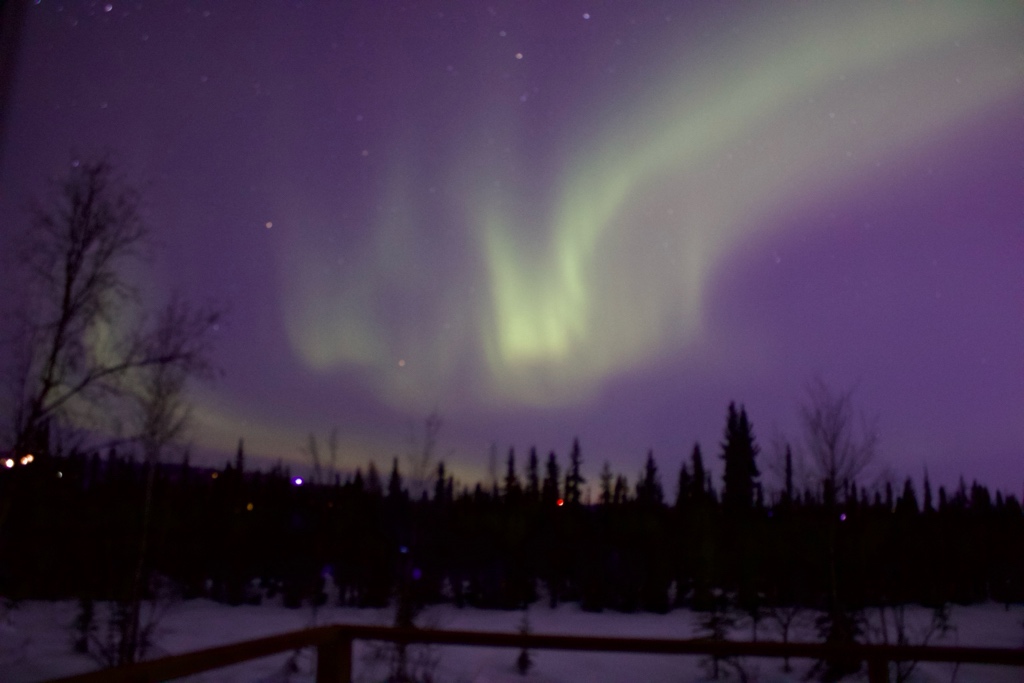
Unedited Image
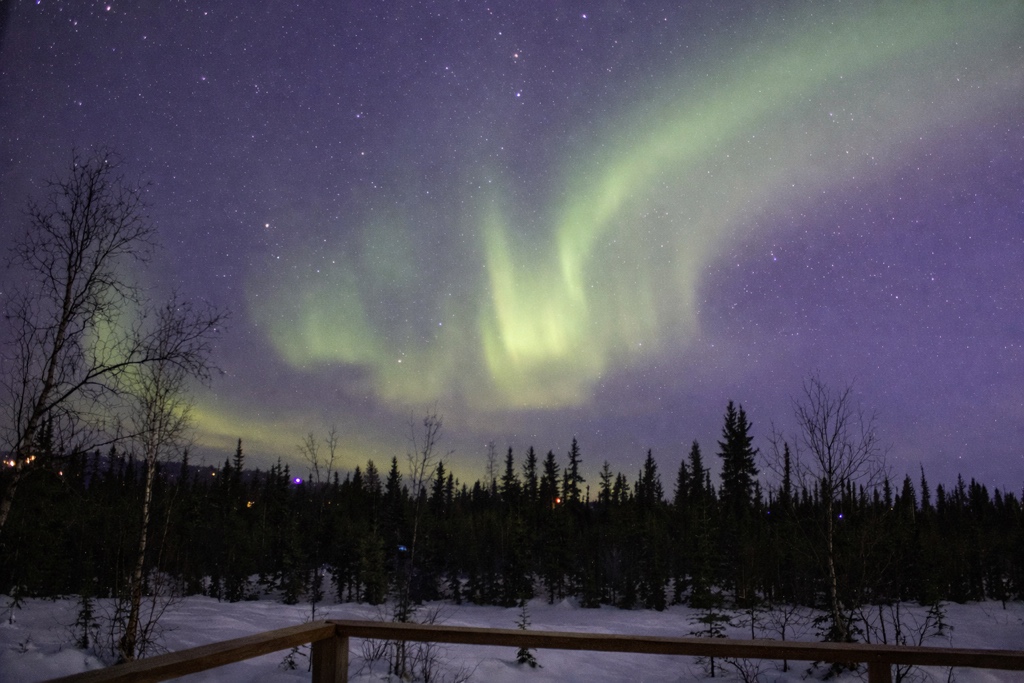
Edited and AI Enhanced
The final step was to return to Copilot with the photographs and ask for help improving their clarity. The aurora appears roughly 50 miles above the earth, and the image contains three different visual zones that benefit from different kinds of processing. Traditional photo editing helped bring out the aurora itself. The foreground and trees remained soft, while the distant stars required a different balance of light. AI enhancement made it possible to work on all three areas separately in minutes. Yet the experience itself was not artificial. The cold, the waiting, the uncertainty, and the sudden movement in the sky were entirely real. AI did not create the aurora or the moment; it helped me prepare for it, capture it, and reveal more of what was truly there. That may be the best way to understand these photographs. They are neither untouched nor invented. They are a collaboration between nature, human intention, and machine assistance—and that may be what photography is becoming in our time.

