Steven J. Dick, Ph.D.
Modern Metrics Barn
Introduction
Chronic absenteeism (missing 10% or more of enrolled school days for any reason) has emerged as one of the most persistent and consequential challenges facing U.S. schools. Chronic absenteeism affects millions of students annually and is strongly associated with lower academic achievement, reduced engagement, and increased likelihood of dropping out (Allensworth & Easton, 2007; Chang & Romero, 2008). Although absenteeism has long been monitored through average daily attendance, the shift toward chronic absence as a metric—accelerated by federal reporting requirements under the Every Student Succeeds Act (ESSA)—has reframed the issue as a matter of equity and early warning, not merely compliance. Historically, schools tended to treat absenteeism as an individual behavioral problem or a disciplinary issue. However, research over the past two decades has demonstrated that chronic absence is a multidimensional phenomenon shaped by structural barriers, school climate, family circumstances, and daily decision‑making processes (Balfanz & Byrnes, 2019).

The modern chronic absenteeism movement began with early work by Chang and Romero (2008), who documented the long‑term academic consequences of chronic absence in the early grades and highlighted the disproportionate impact on low‑income students and students of color. Their findings catalyzed a national shift toward prevention, data transparency, and multi‑tiered systems of support (MTSS). Subsequent research by the Consortium on Chicago School Research (Allensworth & Easton, 2007) further established attendance as a leading indicator of on‑track status and graduation, reinforcing the need for early, proactive intervention. As states and districts adopted chronic absence metrics, the field expanded to include strategies such as mentoring, case management, family engagement, transportation supports, and school climate improvements (Balfanz & Byrnes, 2019). Yet even with these efforts, many districts struggled to reach families consistently and at scale, particularly when absences were driven by misperceptions, competing priorities, or low‑salience daily decisions.
This challenge opened the door for behavioral science, and specifically nudging, as a complementary tool within the attendance‑improvement ecosystem. Nudges—small, low‑cost changes to the way information is presented—are designed to influence behavior by leveraging predictable cognitive tendencies such as present bias, misbeliefs, social norms, and limited attention (Thaler & Sunstein, 2008). In the context of school attendance, nudges typically take the form of personalized messages to parents that correct inaccurate beliefs about absences, highlight the importance of attendance, or provide simple, actionable reminders. Large‑scale randomized controlled trials have found that these interventions can produce modest but meaningful improvements—often reflected as small reductions in total absences and/or a measurable decrease in the share of students who meet the chronic-absence threshold—by helping parents more accurately track absences and prioritize school attendance in daily routines (Rogers & Feller, 2018; Robinson et al., 2021). These effects, while typically not large for any single student, can be substantial in aggregate because nudges are inexpensive, easy to implement, and compatible with existing district systems.
Importantly, nudging is not positioned as a standalone solution. Rather, it is one component of a multi‑tiered, systemic approach that includes structural supports, relationship‑based interventions, and data‑driven monitoring. As Balfanz and Byrnes (2019) argue, chronic absenteeism requires both “conditions for learning” and targeted supports; nudges help address the behavioral and informational dimensions of attendance while other interventions address logistical and structural barriers. In this sense, nudging fills a critical gap: it reaches families who are not intentionally disengaged but are navigating complex schedules, limited information, or competing demands. By making attendance information salient, timely, and easy to act upon, nudges help families translate intentions into behavior—an essential step in reducing chronic absenteeism at scale.
Conceptual Model
Figure 1 presents the conceptual model guiding this paper. It summarizes how chronic absenteeism emerges from the interaction of structural conditions (e.g., transportation, health, housing instability, and school climate) and the behavioral decision processes that shape daily attendance choices. The model’s purpose is to make explicit the mechanisms through which attendance nudges are expected to work—by increasing the salience of absences, correcting misbeliefs, and leveraging social norms and commitment—while also clarifying the limits of nudging when structural barriers are binding. In doing so, the framework links intervention design to short‑term psychological shifts and attendance outcomes, and it situates nudges as one component within a broader, equity‑oriented, multi‑tiered approach to improving attendance.
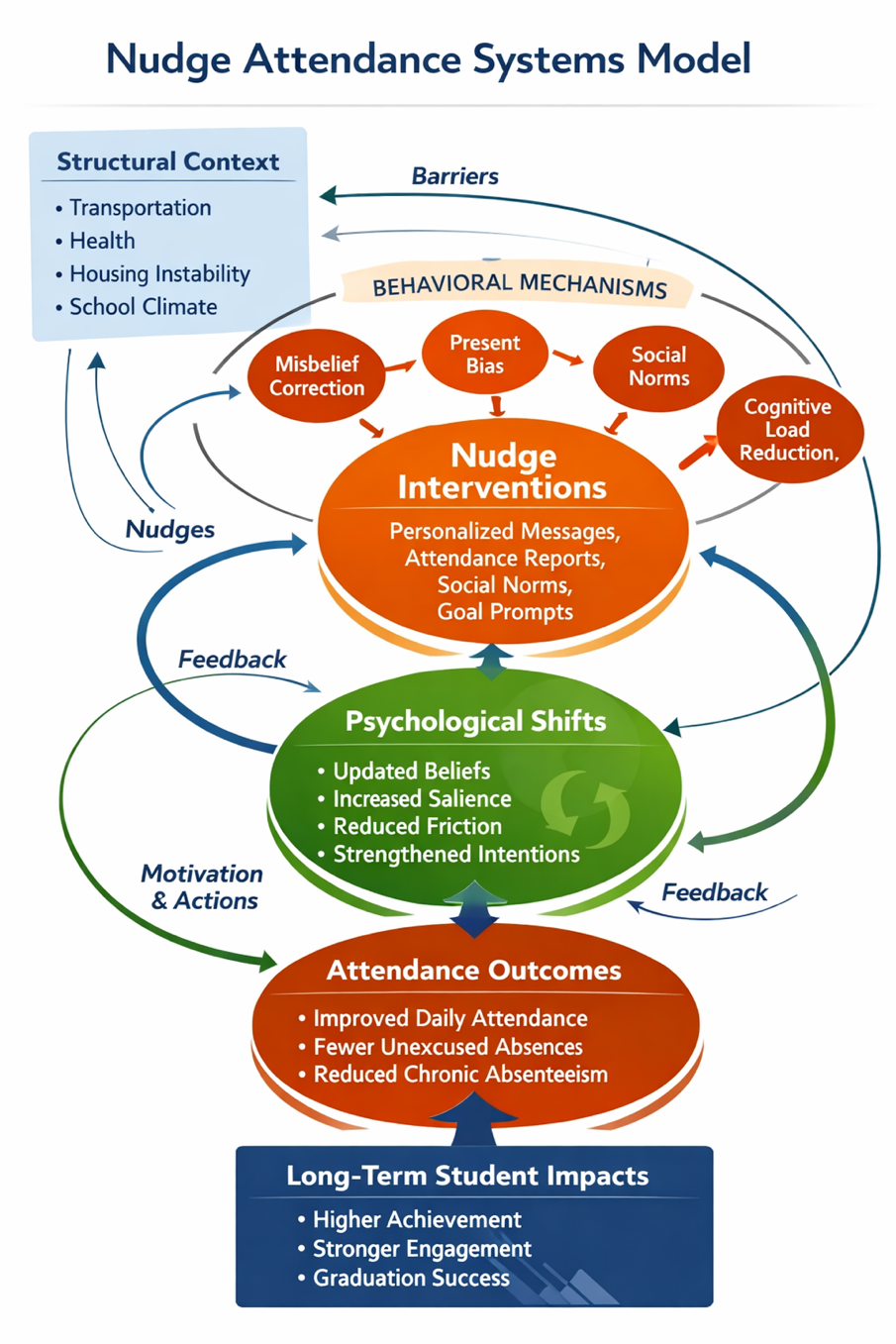
Figure 1 Nudge Logic Model
The conceptual model depicts student attendance as the product of interacting structural and behavioral forces, rather than a simple matter of individual choice. At the top of the figure, structural context—including transportation, health, housing instability, and school climate—represents the persistent conditions that shape whether families can realistically act on their intentions to send children to school. Decades of work on chronic absence show that these barriers are powerful predictors of missed school, especially for students in poverty and marginalized communities (Chang & Romero, 2008). Structural factors, therefore, moderate the impact of any behavioral intervention: nudges can support better decisions, but they cannot fully overcome unsafe routes, unstable housing, or untreated illness.
Within that context, the model centers on behavioral mechanisms targeted by nudges. Drawing on behavioral economics and judgment and decision‑making research, nudges are designed to work with predictable cognitive tendencies rather than against them (Thaler & Sunstein, 2008). Parents often underestimate how many days their child has missed; they also discount long‑term academic consequences relative to short‑term convenience (present bias), and they are influenced by what they believe “most families” do (social norms). Nudges that correct misbeliefs, increase the salience of attendance information, reduce cognitive load, and leverage commitment and consistency are therefore well‑positioned to shift attendance‑related decisions (Rogers & Frey, 2015).
The nudge interventions box in the figure captures concrete instantiations of these mechanisms: personalized attendance messages, data‑informed reports, social norm statements, goal‑setting prompts, and environmental cues. Large‑scale randomized controlled trials show that such interventions can reduce absences and, in some settings, lower chronic absenteeism rates, with effects that are generally positive but modest and context-dependent (Rogers & Feller, 2018). Follow‑up work in early grades similarly finds that targeting parental beliefs about absences yields measurable improvements in attendance, particularly when messages are personalized and easy to understand (Robinson et al., 2021). In the model, arrows from behavioral mechanisms to nudge interventions emphasize that good design is theory‑driven: the content, timing, and framing of messages are chosen to activate specific mechanisms.
These interventions operate by producing psychological shifts, represented in the next layer of the figure. When families receive clear, credible, and personalized information, they update their beliefs about how often their child is absent, the importance of attendance, and what is considered normal in their school community. Attendance becomes more salient in daily planning, friction in morning routines is reduced, and intentions to attend school regularly are strengthened. This pathway is consistent with evidence that belief updating and salience—rather than coercion—are the primary channels through which attendance nudges work (Rogers & Feller, 2018; Robinson et al., 2021). The feedback arrows between nudge interventions, psychological shifts, and attendance outcomes reflect that successful nudges can create reinforcing cycles: improved attendance validates the message, which in turn sustains new beliefs and routines.
The model then links these psychological processes to behavioral outcomes: improved daily attendance decisions, fewer unexcused absences, and reduced chronic absenteeism. This link is well‑established in the broader attendance literature, which shows that even modest reductions in absences can have meaningful effects on academic performance and on‑track status (Allensworth & Easton, 2007; Balfanz & Byrnes, 2019). Over time, as indicated in the bottom layer of the figure, these attendance gains contribute to long‑term student impacts such as higher achievement, stronger engagement, and improved graduation likelihood. Chronic absence in the early grades has been shown to predict later academic difficulties and dropout risk, underscoring why even small, scalable improvements in attendance matter (Chang & Romero, 2008).
Finally, the systems‑thinking layout of the figure is intentional: it situates nudges within, not above, a multi‑tiered and structural response to chronic absenteeism. Balfanz and Byrnes (2019) argue that chronic absence should be addressed through a combination of data‑driven monitoring, universal prevention, targeted supports, and intensive case management. In this framework, nudges function as low‑cost, Tier 1 and Tier 2 tools that can be layered onto broader efforts to improve conditions for learning. The arrows labeled “barriers” and “feedback” signal that while nudges can shift beliefs and behaviors, their effectiveness is constrained by structural context and enhanced when embedded in coherent, equity‑oriented systems.
Limitations
Although the conceptual model is useful for organizing the mechanisms through which attendance nudges may influence behavior, it is vulnerable to several critiques common to both the chronic-absence and “nudge” literatures. At a high level, any model that foregrounds informational and cognitive channels risks overstating individual discretion in contexts where absence is produced by constraints rather than preferences. When transportation is unreliable, housing is unstable, or illness is unmanaged, attendance decisions may not be meaningfully responsive to messaging, even when families fully understand the stakes. In those settings, a nudge-centered model can inadvertently shift attention away from root causes and toward families’ “choices,” creating the impression that absenteeism is primarily a problem of motivation or attention rather than of access and learning conditions (Balfanz & Byrnes, 2019; Chang & Romero, 2008).
A second limitation is empirical and pragmatic: nudge effects are typically modest, context-dependent, and sensitive to implementation quality. Even in high-quality trials, improvements often come from a narrow mechanism (e.g., correcting parents’ misbeliefs about total accumulated absences) rather than from broad shifts in engagement, and the same framing does not reliably generalize across settings or populations (Rogers & Feller, 2018; Robinson et al., 2021). Real-world districts also face “last-mile” issues—data lags, inconsistent contact information, language access, message fatigue, and competing communications—that can attenuate or erase effects relative to controlled studies. Because these operational constraints are not explicitly represented in the conceptual model, the model can be read as more deterministic than the evidence warrants, implying a stable pathway from message exposure to belief updating to attendance gains when, in practice, each link is probabilistic and subject to failure at scale.
Third, the model compresses heterogeneous forms of nonattendance into a single causal story. Attendance problems can reflect distinct processes—such as school refusal driven by anxiety, school withdrawal related to family needs, exclusionary discipline, or school- and policy-level barriers—that call for different assessment and intervention approaches. Reviews of school attendance and absenteeism emphasize that categorical labels (e.g., truancy vs. refusal) and dimensional perspectives (e.g., functional drivers and severity) each capture important variation, and that effective responses often require a multi-tiered, multi-component system rather than a single dominant lever (Kearney et al., 2019). In this sense, the conceptual model is best treated as a partial theory of change for one segment of absenteeism (where informational frictions and planning failures are salient), not as a comprehensive explanation of persistent absence across all students and contexts.
Finally, ethical and equity-based objections constrain how the model should be interpreted and applied. Critics argue that nudges can be manipulative or insufficiently transparent, raising concerns about autonomy and dignity—especially when interventions target families with limited power within school systems (Sunstein, 2015). Relatedly, recent work highlights that nudges can have uneven distributional effects: the same intervention may help some groups more than others, may have negligible effects for families facing scarcity and high cognitive load, or could even stigmatize subgroups if messages are perceived as blaming (Sunstein, 2022). These critiques imply that the conceptual model should include explicit safeguards—clear opt-out options, culturally responsive language, and alignment with material supports—so that nudges complement, rather than substitute for, equity-oriented investments in the structural conditions that enable attendance.
Conclusion
Chronic absenteeism is a persistent, equity-relevant barrier to academic success, and it rarely yields to a single solution. This paper argued that nudging offers a practical contribution to improving attendance by targeting common behavioral frictions—limited attention, present bias, and misbeliefs about accumulated absences—through low-cost, scalable communications with families (Rogers & Feller, 2018; Robinson et al., 2021). The conceptual model integrated these behavioral channels with the structural conditions that shape whether families can act on intentions to attend school consistently (Balfanz & Byrnes, 2019; Chang & Romero, 2008). Framed this way, nudges are best understood as a Tier 1/Tier 2 lever within a broader multi-tiered system: they can strengthen routines and decision-making for many families, while intensive supports and material investments remain essential for students facing binding barriers.
Several implications follow for districts seeking to apply the model. First, effectiveness depends on execution: accurate, timely attendance data; reachable contact lists; language access; and message designs that are clear, respectful, and easy to act on. Second, the model’s limitations suggest that nudges should be paired with well-matched supports—transportation solutions, health connections, relational outreach, and school climate improvements—so that messaging does not substitute for addressing the conditions that produce absence (Balfanz & Byrnes, 2019). Finally, ethical and distributional critiques of nudging underscore the need for transparency, consent-aware practices (e.g., opt-out options), and culturally responsive framing to avoid stigma and unequal benefits (Sunstein, 2015; Sunstein, 2022). When implemented with these safeguards, attendance nudges can be a constructive complement to equity-oriented strategies rather than a replacement for them.
Future research can strengthen the model by identifying which mechanisms matter most for which students, and under what structural constraints. In particular, more work is needed on heterogeneity of effects, optimal timing and frequency of messages, and how nudges interact with tiered interventions and attendance problem types (Kearney et al., 2019). Studies that incorporate families’ perspectives can also clarify when communications feel supportive versus coercive and how trust in schools shapes responsiveness. Overall, the evidence to date suggests that well-designed nudges can shift beliefs and routines in ways that meaningfully reduce absences at scale—especially when embedded in coherent systems that also remove barriers and improve learning conditions.
References
Allensworth, E. M., & Easton, J. Q. (2007). What matters for staying on-track and graduating in Chicago public high schools. Consortium on Chicago School Research. https://consortium.uchicago.edu/sites/default/files/2018-10/07%20What%20Matters%20Final.pdf
Balfanz, R., & Byrnes, V. (2019). Using data and the chronic absenteeism metric to improve conditions for learning. Johns Hopkins University.
Chang, H. N., & Romero, M. (2008). Present, engaged, and accounted for: The critical importance of addressing chronic absence in the early grades. National Center for Children in Poverty. https://www.nccp.org/wp-content/uploads/2008/09/text_837.pdf
Kearney, C. A., Gonzálvez, C., Graczyk, P. A., & Fornander, M. J. (2019). Reconciling contemporary approaches to school attendance and school absenteeism: Toward promotion and nimble response, global policy review and implementation, and future adaptability (Part 2). Frontiers in Psychology, 10, 2605.
Robinson, C. D., Lee, M. G., Dearing, E., & Rogers, T. (2021). Reducing student absenteeism in the early grades by targeting parental beliefs. American Educational Research Journal, 58(5), 997–1031. https://doi.org/10.3102/0002831221991158
Rogers, T., & Feller, A. (2018). Reducing student absences at scale by targeting parents’ misbeliefs. Nature Human Behaviour, 2(5), 335–342. https://doi.org/10.1038/s41562-018-0328-1
Rogers, T., & Frey, E. (2015). Changing behavior beyond the here and now. In G. Keren & G. Wu (Eds.), The Wiley Blackwell handbook of judgment and decision making (pp. 923–951). Wiley. https://appext.hks.harvard.edu/publications/getFile.aspx?Id=1124
Sunstein, C. R. (2015). The ethics of nudging. Yale Journal on Regulation, 32(2), 413–450. https://www.yalejreg.com/print/the-ethics-of-nudging/
Sunstein, C. R. (2022). The distributional effects of nudges. Nature Human Behaviour, 6, 9–10. https://www.nature.com/articles/s41562-021-01236-z
Thaler, R. H., & Sunstein, C. R. (2008). Nudge: Improving decisions about health, wealth, and happiness. Yale University Press.
 Modern Media Barn