For decades, tensions have simmered between Rome and the Society of St. Pius X (SSPX), a traditionalist Catholic group founded in 1970 by Archbishop Marcel Lefebvre. But those tensions erupted into open conflict this summer when the SSPX proceeded with the ordination of four bishops without papal approval, directly defying Pope Leo XIV. The Vatican responded swiftly, declaring the act schismatic and excommunicating the bishops involved. SSPX leaders, in turn, insisted that the sanctions “have no validity,” arguing that they acted out of necessity to preserve the Church’s true tradition.
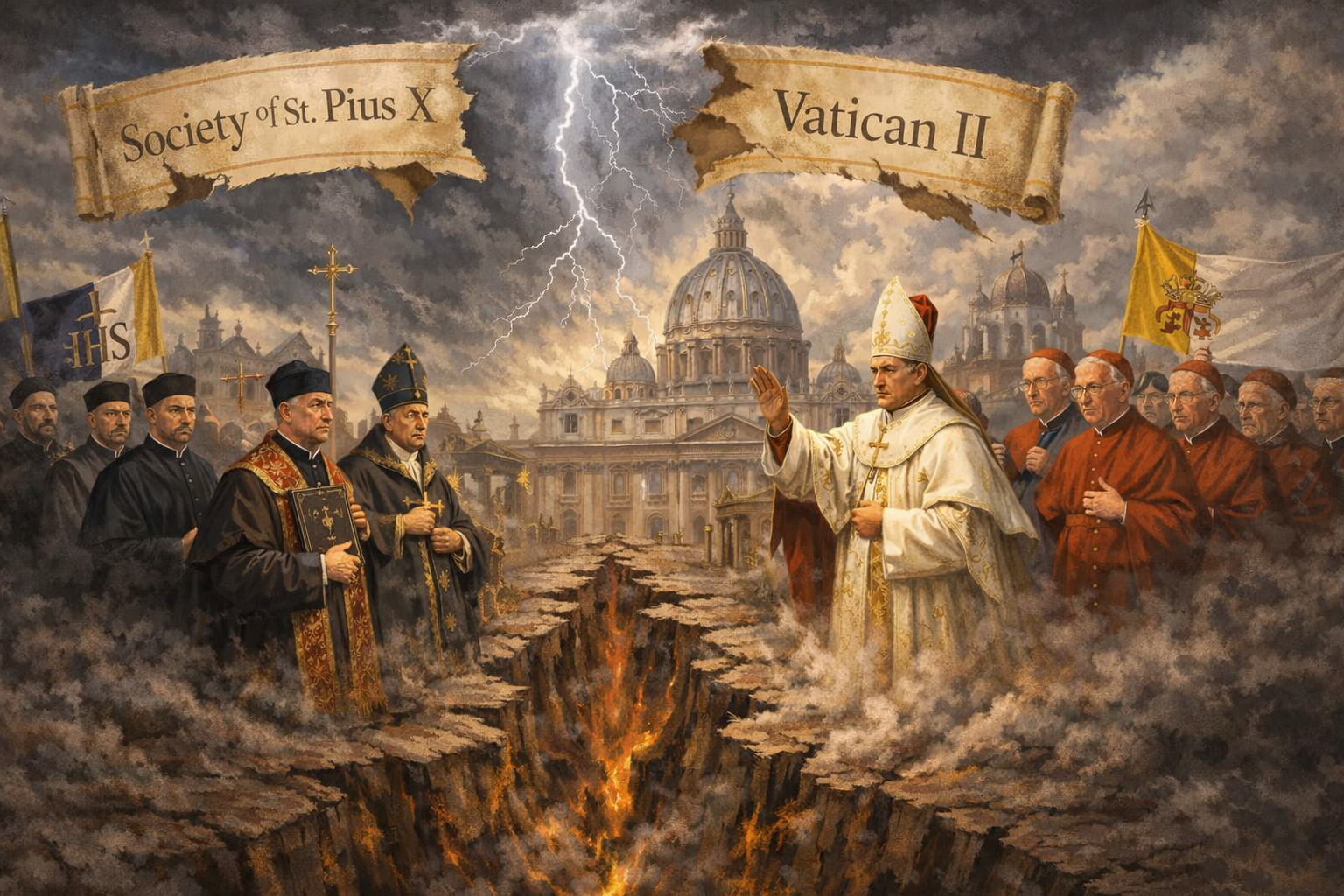
To understand why this conflict has become so explosive, you must look beneath the headlines. The SSPX’s decision wasn’t just about bishops — it was about Vatican II, the sweeping set of reforms introduced in the 1960s that reshaped Catholic worship, governance, and engagement with the modern world. For the SSPX, Vatican II represents a rupture with the Church’s past. For Rome, it represents the Church’s rightful development. And that disagreement is the fault line running through every part of this conflict.
The SSPX’s objections to Vatican II fall into three major areas: religious liberty, ecumenism, and collegiality. Each of these reforms was intended to help the Church speak more effectively to the modern world. Each, in the SSPX’s view, opened the door to confusion, doctrinal compromise, and a weakening of Catholic identity.
The first major point of contention is religious liberty. Vatican II taught that every person has a civil right to practice the religion of their choice, free from coercion. To most Catholics today, this sounds like common sense. But the SSPX argues that this contradicts earlier Church teaching, especially the nineteenth‑century Syllabus of Errors, which rejected the idea that all religions should be treated equally by the state. For traditionalists, Vatican II’s language implies that “error has rights,” a phrase they use often. They believe the Church’s historic claim — that Catholicism is the one true faith — is undermined when the Church affirms a universal right to choose any religion at all. The choice is whether the Catholic Church should attempt to force people to behave according to church teaching or allow the freedom to adopt the Catholic Church in their hearts.
The second issue is ecumenism, Vatican II’s call for dialogue with other Christian denominations and even non‑Christian religions. The Council emphasized that elements of truth can be found outside the Catholic Church and encouraged cooperation wherever possible. The SSPX sees this as a dangerous softening of doctrine. In their view, the Church’s mission is to convert, not to collaborate. They argue that ecumenism blurs the line between truth and error, leading Catholics to believe that salvation can be found outside the Church — something they insist contradicts centuries of teaching. This point speaks to the Catholic Church’s adoption of its place in the world rather than standing alone against all other faiths.
The third major dispute centers on collegiality, the idea that bishops share responsibility for governing the Church alongside the pope. Vatican II encouraged national bishops’ conferences and emphasized the collective role of the episcopacy. The SSPX argues that this dilutes papal authority and introduces a kind of “democratic” decision‑making into a structure they believe was divinely established as hierarchical. They point to the uneven implementation of Vatican II across different countries as evidence that collegiality has led to doctrinal inconsistency and confusion. The unspoken part of this dispute is the role of the whole church, including women and other laypeople. As an individual Catholic, I would have little access to or influence over the Papacy. At the same time, I may have access to my local priest or even Bishop.
And then there is the liturgy — the most visible and emotionally charged change of all. Vatican II reformed the Mass, allowing it to be celebrated in local languages rather than Latin and simplifying many of its rituals. The SSPX insists that the traditional Latin Mass is not just a preference but a safeguard of Catholic doctrine. They argue that the newer Mass reduces reverence, weakens belief in the Real Presence, and breaks continuity with centuries of Catholic worship. While the Vatican has repeatedly said that the dispute is not primarily about the liturgy, for many SSPX faithful, the Mass is the symbol of everything they believe the Church has lost. Is it not a reality that the Mass in a language that is understood can have a more powerful impact on the congregation?
Taken together, these objections form the backbone of the SSPX’s resistance to Vatican II. They believe the Council introduced ambiguity where clarity once existed, modernism where tradition once stood firm, and pastoral flexibility where doctrinal precision was needed. In their eyes, the crisis of declining Mass attendance, shrinking vocations, and widespread confusion about Catholic identity can all be traced back to the reforms of the 1960s.
This is why the recent ordinations matter so much. For the SSPX, new bishops are necessary to preserve what they see as authentic Catholic tradition. For Pope Leo XIV, unauthorized ordinations represent a direct challenge to the unity and authority of the Church. The conflict is not simply administrative — it is theological, historical, and deeply personal for both sides.
As the dust settles, the question remains: can the Church reconcile these competing visions of its identity? Or has the divide over Vatican II grown too wide to bridge? The answer will shape not only the future of the SSPX but the future of Catholicism itself. The impact of the schism goes beyond the Papacy. It goes to the laity’s freedom to participate honestly.

