This report represents a co-authorship between Steven J Dick, Ph.D. and AI CoPilot.
The Ephesians were the people of Ephesus, an important port city in the Roman province of Asia; in a Christian context, the name refers especially to the believers who lived there. Their community appears in Acts 18:19–21 and Acts 19, which describe Paul’s visits and ministry, and in Acts 20:17–38, where he gives a farewell address to the church’s elders. The Letter to the Ephesians, traditionally attributed to Paul, teaches about salvation in Christ, unity among believers, and living out the Christian faith. The church at Ephesus also appears in Revelation 2:1–7 as one of the seven churches addressed in that book.
The biblical accounts place the Ephesian Christian community in a setting where religious change could create social and economic tensions. As a movement rooted in Judaism reached Gentiles as well as Jews, converts faced questions about how faith in Christ related to their previous religious practices and community ties. In Ephesus, these questions intersected with the worship of Artemis, which was closely connected to the city’s identity and commerce. Acts 19 describes the silversmith Demetrius warning that Paul’s teaching threatened both his trade and the prestige of Artemis, illustrating how the spread of Christianity could provoke conflict without implying that every convert had worshipped at the temple or severed all civic and business relationships.
Our tour focuses on the setting of Paul’s ministry in Acts, while the Letter to the Ephesians provides a separate perspective on Christian identity and community. The letter’s authorship and original destination are debated: some early manuscripts omit the words “in Ephesus,” and it may have circulated among several churches. The city therefore offers a useful backdrop for reading the letter, but not proof that every passage addresses a specifically Ephesian situation.
Let’s imagine that it is about AD 55, near the end of Paul’s extended stay in Ephesus. That dating is approximate, but Acts places the famous disturbance involving Demetrius near the end of Paul’s Ephesian ministry, commonly dated around AD 55–56. [biblicalar…eology.org], [paulineletters.com]
One caution before we start: some of the spectacular ruins tourists see at Ephesus today postdate Paul. Most notably, the famous Library of Celsus was built around AD 110–135. Paul never saw it. [hebrewexplorer.com]
Entering the city
As you enter Ephesus, you arrive in one of the significant urban centers of the Roman province of Asia, an old Greek city now firmly within the Roman world. Having come under Roman control in 129 BC, Ephesus was an important port and commercial center as well as a major religious destination. [en.wikipedia.org] Greek culture and Roman political authority are both part of the city you encounter, while one name stands at the heart of its religious identity: Artemis. Her importance to Ephesus will become increasingly clear as our tour continues.
The Ephesus that Paul knew had monumental streets, public buildings, shops and wealthy residences. The route now called Curetes Street had existed in the first century, although some structures visible along it today belong to later periods. [hebrewexplorer.com]
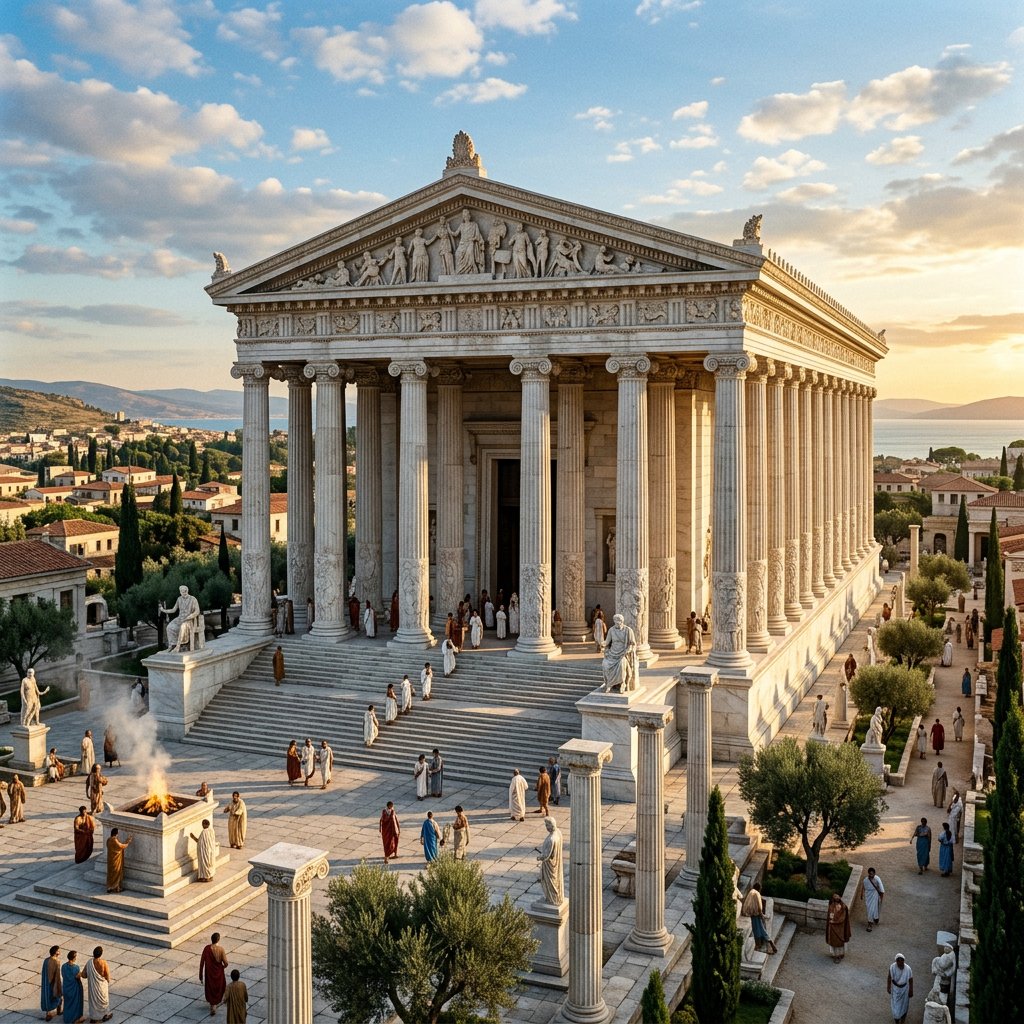
The Temple of Artemis
At the Temple of Artemis, we encounter the religious heart of Ephesian identity. Famous throughout the ancient world and regarded as one of its Seven Wonders, the temple provides an important backdrop for understanding the Christian mission in the city. [en.wikipedia.org] Paul was not preaching in a religious vacuum: his teaching entered a world in which devotion to Artemis was closely bound to the city’s sense of itself. The response described in Acts brings that connection into focus through Demetrius, a silversmith who produced silver shrines associated with the goddess. He complained that Paul’s teaching threatened both the artisans’ business and Artemis’s prestige. [biblicalar…eology.org]
Demetrius’s argument links the craftsmen’s livelihood to the honor of the city’s goddess. From his perspective, Paul’s teaching posed more than a theological challenge: if devotion to Artemis lost standing, the trade associated with her shrines could lose standing as well. His warning that the movement was bad for business thus appealed to both economic interests and civic pride. The intensity of the reaction described in Acts becomes clearer when we read these concerns together, rather than treating religion, commerce, and civic identity as separate issues.
Somewhere in this city, find Paul
Now let’s leave the monumental sights and look for the small Christian movement. Acts describes Paul initially speaking in the synagogue. After facing opposition, he moved his teaching to what is identified as the hall or lecture hall of Tyrannus. Acts says that this teaching continued for two years. [paulineletters.com]
We cannot take you to an identified archaeological building and confidently say, “Here’s Paul’s classroom” but conceptually, this is important. Imagine people coming to hear this Jewish missionary teaching about Jesus in the midst of an overwhelmingly Greco-Roman religious environment.
And the movement apparently spreads beyond Ephesus. Acts portrays Paul’s Ephesian period as a base from which the message reached people throughout the Roman province of Asia. [paulineletters.com]. So Ephesus functions almost like Paul’s regional headquarters during this period.
A Tradition of Magic
The religious world of Ephesus included a tradition of magic in which practitioners used written spells and ritual knowledge to seek influence over spiritual powers. These practices were concerned not with entertainment but with matters such as healing and protection. Acts 19 portrays this world through accounts of exorcism and the possession of valuable books on magic, offering a glimpse of the older practices encountered by the Christian movement. [paulineletters.com] Against this background, Ephesians’ language of rulers, authorities, powers, and spiritual forces sounds less abstract. Its emphasis on Christ’s supremacy over powers and the armor of God speaks to a world deeply conscious of supernatural power, although this does not mean that every passage in the letter should be explained directly by Ephesian magical practices.
Within this setting, Acts describes believers openly confessing their former practices and people who had practiced magic gathering their books and burning them in public. The destruction of these valuable books marked a costly and visible rejection of older magical traditions rather than an attempt to combine them with faith in Christ. In the narrative, this renunciation follows the failed exorcism attempted by the sons of Sceva and the growing honor given to Jesus’ name. The burning of the books thus expresses a change in allegiance: the converts were casting off practices associated with their former way of seeking spiritual power (Acts 19:17–20).
The comparison between apostolic ministry and magical practice comes into focus through Paul, the apostle at the center of this account. Acts attributes the healing of the sick and the departure of evil spirits to God working through him, even describing healings associated with cloths that had touched him. Alongside these events, it tells of itinerant Jewish exorcists, including the sons of Sceva, who tried to invoke the name of Jesus whom Paul preached but were overpowered by the man they sought to deliver. Both accounts concern illness or spiritual affliction, yet Acts presents a decisive difference in the source of authority: God acts through Paul, while the exorcists’ attempt to appropriate Jesus’ name fails. The contrast is therefore not simply between actions that looked different, but between divine power and an attempt to use a sacred name as a technique for obtaining it. Acts 19:11–20 Read alongside Ephesians, this distinction gives context to the letter’s portrayal of a struggle extending beyond human opponents into a larger spiritual conflict.
The Great Theatre
As we approach the Great Theatre, the tour moves from the city’s religious traditions to the scene of a public confrontation. The theatre was already undergoing Roman expansion beginning around AD 40, with further modifications continuing during and after Paul’s lifetime. [whitman.edu] According to Acts 19, it was into this space that an angry crowd rushed during the disturbance stirred up by Demetrius and the craftsmen. Caught in the uproar were Gaius and Aristarchus, two Macedonians whom Acts identifies as Paul’s traveling companions. The crowd seized them and dragged them into the theatre, placing Paul’s associates at the center of the confrontation. Paul wanted to enter the assembly himself, but his followers and friendly provincial officials urged him not to do so. [biblicalar…eology.org]
Gaius remains a relatively indistinct figure in this episode: Acts tells us that he was Macedonian and traveled with Paul, but offers no account of his words or actions in the theatre. Because Gaius was a common name, he should not automatically be identified with the Gaius of Derbe, Paul’s host at Corinth, or the recipient of 3 John. [Bible Gateway] Aristarchus, by contrast, appears elsewhere in the New Testament. Acts 20:4 identifies him with Thessalonica, and Acts 27:2 places him alongside Paul at the beginning of the voyage toward Rome. Colossians 4:10 calls him Paul’s fellow prisoner, while Philemon 24 names him among Paul’s fellow workers. These later references show that the man seized at Ephesus continued to be associated with Paul’s ministry beyond this dangerous encounter. [GotQuestions.org]
Imagine standing near the theatre as the crowd’s chant rises: “Great is Artemis of the Ephesians!” With Gaius and Aristarchus caught in the assembly and Paul being urged to stay away, the scene brings the personal risks of the mission into view. The dispute over teaching, trade, and the honor of Artemis was no longer confined to argument; it had drawn Paul’s companions into a volatile public gathering. This particular event is known from the account in Acts, which supplies the narrative behind our imagined scene. [walkswithjesus.org]
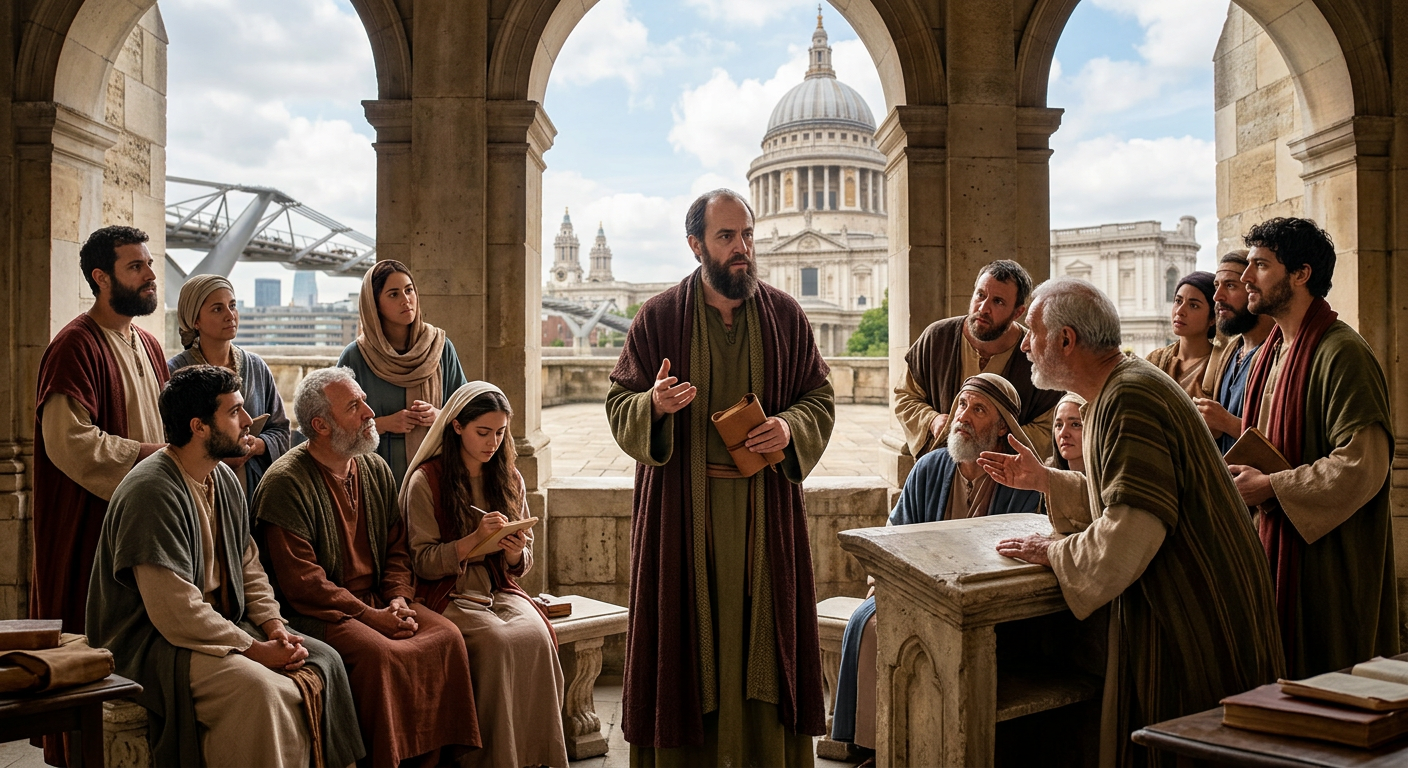
Being an Ephesian Christian
To understand what this new faith might mean, imagine that you have recently joined the Christian movement in Ephesus. You still live among the same neighbors, surrounded by the city’s familiar social, religious, and economic life. The monumental presence of Artemis remains, as does Roman authority; becoming a Christian has not removed you from the world you have always known. Instead, it asks you to see that world differently and to reconsider your place within it. From the perspective of a new believer, the city’s familiar surroundings now raise a new set of questions.
- Who is actually Lord?
- Where does spiritual power really reside?
- Who constitutes God’s people?
- What happens when Jews and Gentiles worship together?
- What does conversion require of your former religious practices?
- How should this new identity affect your family and relationships?
- What happens when your religion disrupts commerce or civic expectations?
The historical tour provides a setting for one of Ephesians’ recurring themes: identity. The believers’ new relationship with God also changes their relationship with one another, inviting them to understand themselves as a community shaped by Christ rather than simply by their former way of life. Against the backdrop of a city dominated by impressive religious, political, and civic institutions, the letter’s claim that the church itself is now God’s dwelling place takes on particular significance. For people living near one of antiquity’s most famous temples, this offers a strikingly different way of imagining where God’s presence belongs.
This new identity is also expressed in the relationship between Jewish and Gentile believers. Ephesians describes them as one new humanity, a claim that reaches beyond a general appeal to kindness or goodwill. Christ has created a community whose shared identity transcends deeply entrenched divisions in the ancient world. Read in the setting of Ephesus, the letter’s emphasis on belonging therefore brings together two ideas: believers have entered a new relationship with God, and they must learn to live in a new relationship with one another.
The image of the armor of God in Ephesians 6 brings this discussion of identity into the language of spiritual conflict. The Christian community is not pictured as living in a peaceful religious bubble, untouched by the pressures of its surroundings. Acts portrays the Ephesian movement amid competing claims about gods, supernatural powers, economic interests, and civic loyalties. Against that backdrop, the armor imagery connects the believers’ new identity with the challenge of living faithfully in a contested world. The tour thus helps bring the letter’s themes together: a new relationship with God, a shared life across inherited divisions, and a calling to remain faithful amid conflict.
References
BAS Staff. (2026, January 20). Biblical riot at Ephesus: The archaeological context. Biblical Archaeology Society. https://www.biblicalarchaeology.org/daily/biblical-sites-places/biblical-archaeology-places/biblical-riot-at-ephesus/
Curetes Street and the Library of Celsus, Ephesus. (n.d.). Hebrew Explorer. https://hebrewexplorer.com/archaeology/ephesus-curetes-street-celsus-library/
Diong, T. (2026, October 26). Paul in Ephesus: Dates and sources. Pauline Letters. https://paulineletters.com/explore/paul-in-ephesus
Ephesus. (n.d.). In Wikipedia. Retrieved November 3, 2026, from https://en.wikipedia.org/wiki/Ephesus
Ephesus—the theatre and the Temple of Artemis. (n.d.). Walk With Jesus. https://walkswithjesus.org/archaeology/ephesus/
Gaius. (n.d.). Bible Gateway. https://www.biblegateway.com/resources/encyclopedia-of-the-bible/Gaius
Got Questions Ministries. (2026, July 17). Who was Aristarchus in the Bible? GotQuestions.org. https://www.gotquestions.org/Aristarchus-in-the-Bible.html
Introduction to Ephesians. (n.d.). ESV.org. https://www.esv.org/resources/esv-global-study-bible/introduction-to-ephesians/
The Theatre at Ephesus (near Selçuk, Turkey). (n.d.). Whitman College. https://www.whitman.edu/theatre/theatretour/ephesus/commentary/Ephesus.commentary.htm
Topical Bible: Ephesus: Paul’s epistle to the Ephesians. (n.d.). Bible Hub. https://biblehub.com/topical/naves/e/ephesus–paul’s_epistle_to_the_ephesians.htm
Topical Bible: Paul in Ephesus. (n.d.). Bible Hub. https://biblehub.com/topical/p/paul_in_ephesus.htm
Bible Passages Used
Acts
- Acts 18:19–21 — Paul’s initial visit to Ephesus (introduction).
- Acts 19 — The principal narrative behind the tour: 19:1–7, disciples in Ephesus; 19:8–10, synagogue teaching and the hall of Tyrannus (Stop 4); 19:11–20, miracles, exorcism, and the burning of magical books (Stop 5); 19:23–41, Demetrius, Artemis, and the theatre disturbance (Stops 3 and 6). The crowd’s quoted chant appears in 19:28 and 19:34.
- Acts 20:17–38 — Paul’s farewell to the Ephesian elders (introduction).
- Acts 20:4; 27:2 — Aristarchus’s connection with Thessalonica and his later travels with Paul (The Great Theatre).
Ephesians
- Ephesians 1–6 — The letter as a whole is introduced and discussed throughout the tour.
- Ephesians 1:19–23 — Christ’s supremacy over rulers, authorities, and powers (Stop 5).
- Ephesians 2:1–10 — Salvation and the believers’ changed condition (introduction and concluding discussion).
- Ephesians 2:11–22 — Jews and Gentiles united as one new humanity; the church as God’s dwelling place (Stop 7 and conclusion).
- Ephesians 4:17–32 — Putting away the former way of life and living a new identity (Stop 7 and conclusion).
- Ephesians 5:21–6:9 — Faith expressed in household relationships (Stop 7).
- Ephesians 6:10–20 — The armor of God and spiritual conflict, especially 6:12 (Stop 5 and conclusion).
Colossians and Philemon
- Colossians 4:10 — Aristarchus described as Paul’s fellow prisoner (The Great Theatre).
- Philemon 24 — Aristarchus named among Paul’s fellow workers (The Great Theatre).
Revelation
- Revelation 2:1–7 — The message to the church at Ephesus (introduction).

