Modern Media Barn White Paper — March 2026
Executive Summary
The global creator economy has matured into a multi‑hundred‑billion‑dollar market powered by platform advertising, direct fan payments, sponsorships, and product sales. Direct platform payouts alone rarely constitute a full‑time income for most creators; instead, sustainable revenue is achieved by stacking channels: short‑form discovery, long‑form depth, and direct‑relationship subscriptions. As production expectations rise, creators increasingly face operating costs comparable to small media firms, making net—not gross—income and channel ownership critical to long‑term sustainability. This paper synthesizes 2024–2026 benchmarks across major platforms and outlines a practical promotion and distribution blueprint, with APA‑style references throughout (Backlinko, 2025; Lenos, 2026; Podscan, 2025).

Market Overview
Substack reports more than 5 million paid subscriptions and 20+ million monthly active subscribers, reflecting rapid growth in direct‑to‑writer models (Backlinko, 2025). Across video, YouTube ad revenue topped the mid‑$30B range in 2024 per industry syntheses, with creators typically receiving a 55% share in the relevant programs (Marketing LTB, 2025; Lenos, 2026). Short‑form ecosystems (TikTok, Reels, Shorts) deliver massive reach. Still, their direct per‑view payouts are structurally lower than those of long‑form video and newsletters, pushing most professionals to treat short‑form primarily as audience acquisition rather than as core income (Influencer Marketing Hub, 2025; Post‑Bridge, 2025; KiwiBox, 2026).
Revenue Architecture
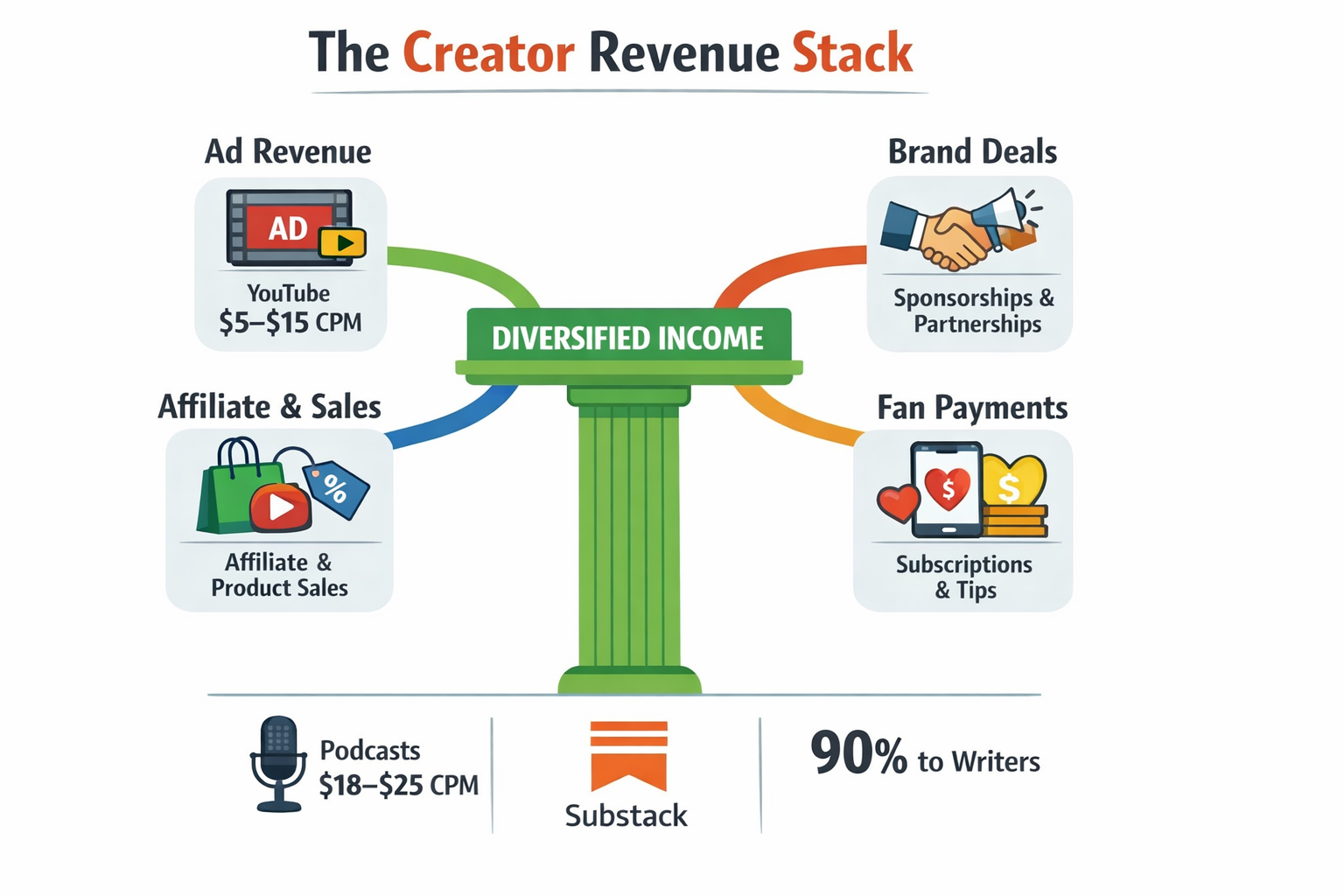
Creator income is best understood as a diversified revenue stack rather than a single paycheck, with most sustainable businesses combining multiple monetization channels that vary in scale, stability, and control. Creator revenue falls into four primary buckets: (a) platform ad‑share payouts; (b) brand deals and sponsorships; (c) affiliate and product sales; and (d) direct fan payments (subscriptions, memberships, tips). Benchmarks vary by niche and geography, but directional ranges help with planning: YouTube long‑form often yields about $5–$15 per 1,000 monetized ad views to creators (Lenos, 2026; Marketing LTB, 2025). Podcast host‑read ads commonly transact around $18–$25 CPM, while programmatic inventory is often lower (Podscan, 2025). Substack’s fee model leaves roughly 90% of subscription revenue to writers, excluding processing (Substack Course, 2023; Backlinko, 2025).
Platform Payout Benchmarks
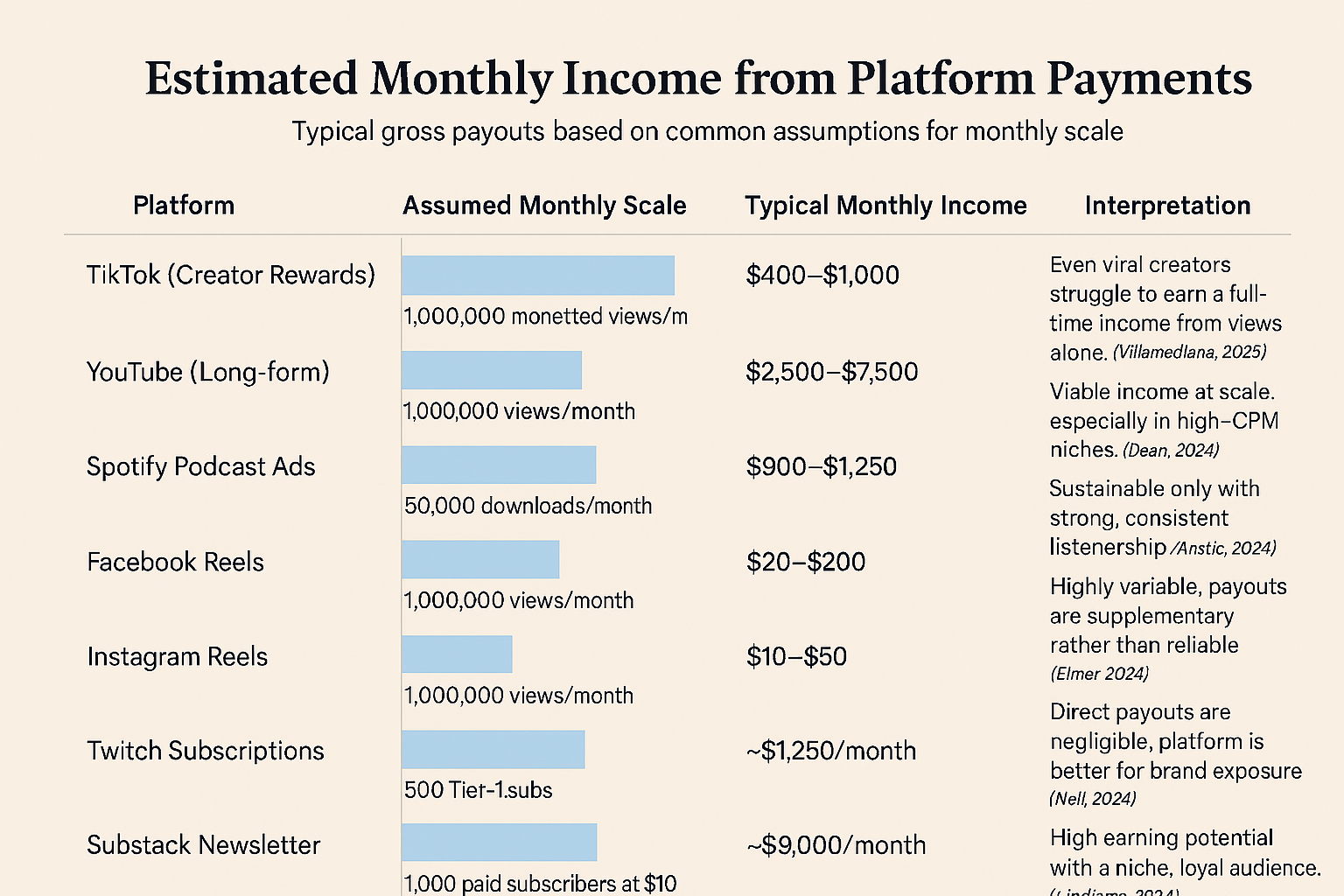
- TikTok — Creator Rewards payouts typically about $0.40–$1.00 per 1,000 qualified views; videos must be at least one minute to qualify (Influencer Marketing Hub, 2025; TikTok Help Center, 2026).
- YouTube long‑form — ~$5–$15 revenue per 1,000 monetized ad views to creators; higher in premium niches and Tier‑1 markets (Lenos, 2026; Marketing LTB, 2025).
- YouTube Shorts — materially lower RPMs than long‑form due to pooled revenue sharing (Lenos, 2026).
- Spotify (Podcasts) — host‑read ad CPMs around $18–$25 per 1,000 downloads; programmatic ads lower (Podscan, 2025).
- Facebook Reels — post‑2025 unified content monetization typically yields ~$0.02–$0.20 per 1,000 views for many creators (Post‑Bridge, 2025; KiwiBox, 2026).
- Instagram Reels — bonuses largely discontinued; direct per‑view payouts minimal; better used for reach and brand demand creation (ClickAnalytic, 2026; Influencer Marketing Hub, 2024).
- Twitch subscriptions — ~\$2.50 per Tier‑1 subscriber/month at a 50/50 split; higher splits possible for select Partner Plus tiers; ads typically ~$2–$8 CPM (Streams Charts, 2026; MiniWebtool, 2026).
- Substack — creators typically keep ~90% of paid subscription revenue after the platform’s 10% fee (Substack Course, 2023; Backlinko, 2025).
Monetization‑Relevant Length Rules
Length rules shape economics. TikTok’s Creator Rewards requires videos of at least 60 seconds and pays only on qualified For‑You views ≥ five seconds (TikTok Help Center, 2026). YouTube has no minimum ad length, but at 8 minutes, creators can enable mid‑roll placements, which increase impressions per view (YouTube Help, 2023). Instagram Reels supports up to 10 minutes in recent updates, yet direct payouts are limited; Facebook Reels eligibility typically centers on short clips ≤ 60 seconds within Meta’s newer monetization model (ClickAnalytic, 2026; Post‑Bridge, 2025; KiwiBox, 2026).
Audience Development Model
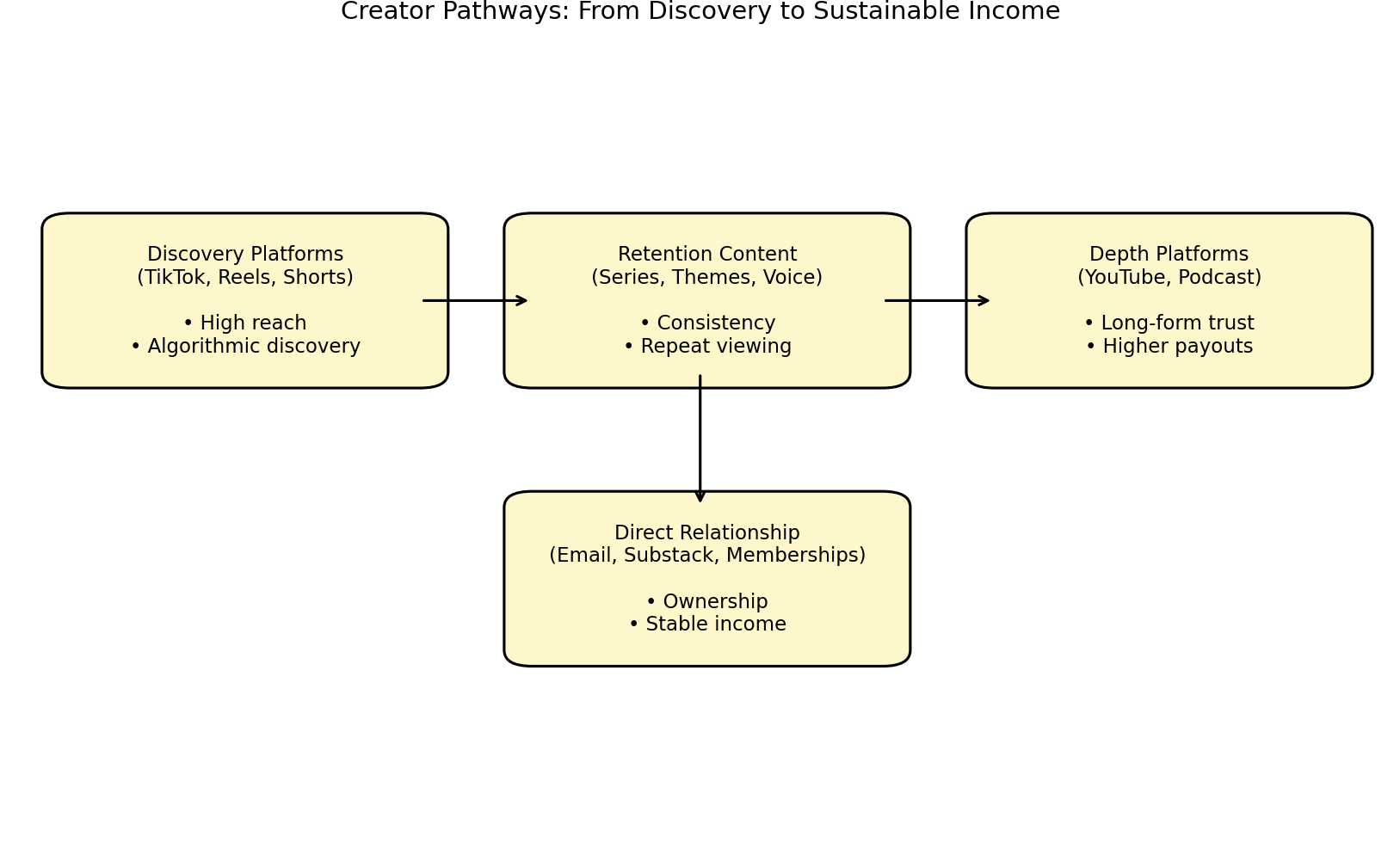
Audience building proceeds from discovery to retention to depth, and finally to a direct relationship. Short‑form video supplies discovery at scale; long‑form formats on YouTube and podcasts cultivate trust and higher earning capacity; direct channels such as email and paid memberships stabilize revenue. Practically, the same story is edited into multiple cuts—15–30 seconds for short‑form, 10–20 minutes for YouTube, and episodic audio—then packaged for subscribers. This pathway reflects economic incentives across platforms, not merely creative preference (Lenos, 2026; Podscan, 2025; Substack Course, 2023).
Promotion and Distribution Blueprint
Plan campaign content that begins with short‑form discovery assets designed for completion and shareability. Use these to seed traffic to cornerstone long‑form videos or podcast episodes that expand the idea and capture watch time or downloads. From there, invite the most engaged viewers to a free email list and convert a portion to paid subscriptions or memberships with clear, ongoing benefits (e.g., bonus episodes, office hours, templates). Key operating metrics: short‑form completion rate and saves; YouTube click‑through rate and average view duration; podcast download velocity in the first 30 days for ad inventory; email open and paid‑conversion rates. Allocate brand deals and affiliate promotions to long‑form or newsletter placements where context and trust are strongest (Marketing LTB, 2025; Podscan, 2025; Backlinko, 2025).
Illustrative Income Stack (Monthly, Gross)
Assume a creator publishes weekly on YouTube (long‑form) and podcasts, and maintains daily short‑form clips, plus a paid newsletter tier. At 400,000 YouTube monetized views (~$5–$10 RPM), ad revenue can reach roughly $2,000–$4,000; at 40,000 monthly podcast downloads (~$18–$25 CPM host‑read inventory), ads can add ~$720–$1,000 per mid‑roll slot; with 500 paid newsletter subscribers at $10/month and a 90% creator share, subscriptions contribute ~$4,500. Short‑form discovery may add nominal direct payouts but drives the funnel (Lenos, 2026; Podscan, 2025; Substack Course, 2023).
Cost Structure and Operating Expenses for Content Producers
Revenue potential in the creator economy must be evaluated net of operating expenses, which have risen as content production has professionalized. While entry barriers remain relatively low, sustainable creator businesses increasingly resemble small media firms, with recurring costs tied to production quality, distribution, labor, and compliance. Industry surveys and creator‑focused financial analyses consistently show that expenses scale with output frequency, format complexity, and monetization maturity rather than audience size alone.
Core Expense Categories
Most creator expenses fall into five recurring categories:
- Equipment and production gear. Cameras, microphones, lighting, computers, and related peripherals represent the highest upfront costs for many creators. Higher‑end video and podcast formats require periodic reinvestment as hardware depreciates or becomes obsolete, particularly for creators producing long‑form or broadcast‑quality content.
- Software and platform tools. Editing software, design tools, scheduling platforms, analytics dashboards, email service providers, and AI‑assisted production tools are now standard. Surveys indicate that the majority of professional creators maintain multiple paid subscriptions, turning software into a meaningful fixed monthly cost rather than a one‑time expense.
- Labor and outsourced services. As output increases, creators commonly outsource editing, thumbnail design, research, community moderation, or management. Even solo creators increasingly rely on contractors paid per video or per campaign, converting time constraints into cash expenses.
- Studio space, hosting, and infrastructure. While many creators begin at home, professionalization often leads to rented studio space, co‑working facilities, podcast studios, or cloud hosting for websites and digital products. These costs tend to scale with brand partnerships and production cadence rather than follower count.
- Administrative, marketing, and compliance costs. Payment processing fees, accounting services, insurance, marketing spend, and platform fees reduce gross revenue. Independent creators also bear full responsibility for self‑employment taxes and financial administration, which represent a non‑trivial share of net income even when revenues are modest.
Fixed vs. Variable Cost Dynamics
Creator expenses can be divided into fixed costs (software subscriptions, insurance, baseline equipment depreciation) and variable costs(contract labor, studio rentals, paid promotion). Early‑stage creators tend to operate with lower fixed costs but higher time investment, while scaling creators trade time for variable cash outlays. This shift improves output consistency but compresses margins if revenue diversification does not keep pace.
Notably, many high‑visibility platforms emphasize gross earnings without accounting for these costs, leading to overstated perceptions of creator profitability. Industry reports consistently show that only a small minority of creators generate income sufficient to comfortably absorb professional‑grade operating expenses without diversified revenue streams.
Expense structure reinforces the importance of stacking monetization channels. Platform ad‑share alone often fails to cover rising fixed costs, particularly for video‑heavy formats. In contrast, subscriptions, sponsorships, and owned‑channel product sales offer higher margins and greater predictability, allowing creators to reinvest in quality, delegation, and risk mitigation. As a result, expense management is not merely an operational concern but a core strategic variable in creator business sustainability.
Risks and Policy Volatility
Platform policy changes (e.g., Meta’s consolidation of bonus programs), advertising seasonality, and geography‑driven CPM variance can materially affect income. Mitigation includes multi‑platform distribution, a shift toward owned channels (email, memberships), and, when possible, reserving long‑form inventory for higher‑CPM niches (Post‑Bridge, 2025; KiwiBox, 2026; Lenos, 2026).
Recommendations
- Adopt a hub‑and‑spoke content plan: short‑form for reach; long‑form for depth; subscriptions for stability (Lenos, 2026; Podscan, 2025).
- Design to length rules up front (e.g., 60‑second minimum for TikTok Rewards; 8‑minute mid‑roll threshold on YouTube) to avoid leaving revenue on the table (TikTok Help Center, 2026; YouTube Help, 2023).
- Track unit economics by format: RPM/CPM, subscriber lifetime value, and qualified‑view definitions on short‑form (Influencer Marketing Hub, 2025; Post‑Bridge, 2025).
- Build an email list early and convert the top 5–10% of the audience to paid over time with consistent, differentiated value (Backlinko, 2025; Substack Course, 2023).
Conclusion
The creator economy has entered a phase of structural maturity. What began as an experimental extension of social media platforms has evolved into a complex, multi‑channel media ecosystem in which creators function less as individual personalities and more as independent operators managing diversified revenue portfolios. Across platforms, the core economic pattern is consistent: direct platform payouts alone rarely sustain professional‑grade production, while long‑term viability depends on stacking monetization channels that balance reach, margin, and control.
This report has shown that creator income is best understood not as a single stream but as an architecture. Short‑form platforms excel at discovery and audience acquisition but deliver limited direct payouts. Long‑form video, podcasts, and newsletters generate higher unit economics through advertising and sponsorships, while subscriptions, memberships, and owned products provide the greatest stability and strategic leverage. The most resilient creator businesses intentionally design content, length, and distribution around these economic incentives rather than relying on platform algorithms alone.
Equally important, gross revenue figures obscure the true financial reality of creator work. As production quality expectations rise and output scales, creators incur operating expenses that resemble those of small media firms: equipment depreciation, software subscriptions, outsourced labor, infrastructure, and administrative costs. These expenses routinely absorb a meaningful share of earnings, reinforcing the need to evaluate success in net—not gross—terms. The persistence of platform‑centric earnings narratives has contributed to widespread misperceptions about creator profitability, particularly among early‑stage entrants.
Policy volatility and platform rule changes further underscore the importance of diversification and ownership. Algorithm updates, shifts in monetization programs, and advertiser demand cycles can materially affect income with little notice. Creators who prioritize owned channels—email lists, memberships, and direct customer relationships—are better positioned to manage this volatility, preserve pricing power, and reinvest in sustainable growth.
Taken together, the evidence suggests that the creator economy’s next phase will not be defined by virality alone, but by operational discipline. Successful creators increasingly behave as portfolio managers: allocating effort across formats, platforms, and revenue streams to optimize risk‑adjusted returns. For creators, platforms, educators, and policymakers alike, the implication is clear. The creator economy should be understood not as a lottery driven by algorithms, but as an emerging class of small digital enterprises governed by familiar principles of media economics, cost structure, and strategic control.
References
Acast Ads. (n.d.). How much does podcast advertising cost? https://advertise.acast.com/news-and-insights/how-much-does-podcast-advertising-cost
Backlinko. (2025, December 29). Substack user and revenue statistics (2026). https://backlinko.com/substack-users [backlinko.com]
ClickAnalytic. (2026, January 13). How much does Instagram pay for 1000 views in 2026? https://www.clickanalytic.com/how-much-does-instagram-pay-for-1000-views/
IAB. (2025, November 20). 2025 Creator economy ad spend & strategy report. https://www.iab.com/insights/2025-creator-economy-ad-spend-strategy-report/
Influencer Marketing Hub. (2024, November 19). What is an Instagram Reels Play Bonus and how does it work? https://influencermarketinghub.com/reels-play-bonus/
Influencer Marketing Hub. (2025, March 25). How much does TikTok pay in 2025? https://influencermarketinghub.com/how-much-does-tiktok-pay/ [ofcpa.pro]
KiwiBox. (2026, March 12). Facebook payouts in 2026 – How much your views are actually worth. https://www.kiwibox.com/facebook-payouts/ [kiwibox.com]
Lenos. (2026, February 26). YouTube CPM & RPM rates 2026: Average, niches, countries & more. https://www.lenostube.com/en/youtube-cpm-rpm-rates/ [lenostube.com]
Marketing LTB. (2025, October 25). YouTube ads statistics 2025. https://marketingltb.com/blog/statistics/youtube-ads-statistics/ [marketingltb.com]
MiniWebtool. (2026, March 12). Twitch earnings calculator. https://miniwebtool.com/twitch-earnings-calculator/
Podscan. (2025, November 7). Podcast advertising rates & CPM benchmarks for 2025. https://podscan.fm/blog/podcast-advertising-rates-cpm-benchmarks-2025 [podscan.fm]
Post‑Bridge. (2025, December 21). Facebook Reels pay per 1,000 views: It’s not $4–$10. https://www.post-bridge.com/blog/how-much-does-facebook-reels-pay-per-1000-views
Statista. (2026, February 5). YouTube: Global advertising revenues, by quarter (2018–2025).https://www.statista.com/statistics/289657/youtube-global-quarterly-advertising-revenues/ (Add this) [statista.com]
Streams Charts. (2026). Twitch sub revenue calculator. https://streamscharts.com/tools/twitch-sub-revenue-calculator [streamscharts.com]
TikTok Help Center. (2026). How rewards work (Creator Rewards Program). https://support.tiktok.com/en/business-and-creator/creator-rewards-program/how-rewards-work
YouTube Help. (2023). YouTube advertising formats. https://support.google.com/youtube/answer/2467968?hl=en
 Modern Media Barn
One thought on “Navigating the Creator Economy: Revenue Strategies and Insights”