Abstract
Early childhood education (ECE) has traditionally been defended on moral and social grounds. However, a growing body of economic research shows that it represents a highly effective public investment. This paper examines the economic returns of high-quality early childhood education in the United States. It synthesizes longitudinal and contemporary evidence. The paper draws on cost–benefit analyses, randomized program evaluations, and large-scale policy studies. It shows that well-designed ECE programs generate benefits that exceed their costs through multiple channels. These channels include improved educational attainment and higher lifetime earnings. They also include increased parental labor‑force participation. Additionally, there are reduced public expenditures on remedial education, criminal justice, and health care. These effects contribute to long-run productivity growth, fiscal sustainability, and reduced economic inequality. At the same time, the paper critically evaluates key limitations. These include concerns about scalability and variation in program quality. They also cover the fade-out of short-term academic gains and trade-offs between universal and targeted approaches. The evidence shows that economic returns to early childhood education are substantial. However, they depend on sustained investment, program quality, and integration with broader educational and social policies. When these conditions are met, early childhood education becomes one of the most effective strategies. It strengthens human capital. It also supports long-term economic stability.

Introduction
For decades, debates about early childhood education (ECE) in the United States have often been framed primarily in moral or social terms. While these arguments remain important, they are frequently vulnerable in periods of fiscal constraint. A substantial body of economic research, however, reaches a far more robust conclusion: high-quality early childhood education is also a strong economic investment. Across methodologies and time periods, studies consistently show that ECE generates benefits that exceed its costs, with estimated benefit–cost ratios ranging from approximately 2:1 to as high as 18:1, depending on program design, quality, and the population served (Council of Economic Advisers [CEA], 2014; Baulos et al., 2024). Recent analyses further confirm that these returns are not limited to small historical model programs but also appear in large-scale contemporary initiatives (Jackson et al., 2025).
These returns are grounded in longitudinal evidence rather than in short-term test-score gains. Economic evaluations of early childhood education typically examine a wide range of outcomes across the life course, including educational attainment, earnings, health, criminal justice involvement, and public expenditures. When assessed through this broader lens, ECE functions not as discretionary social spending, but as a foundational investment in human capital and long-run economic stability (CEA, 2014; Heckman et al., 2016).
Mechanisms
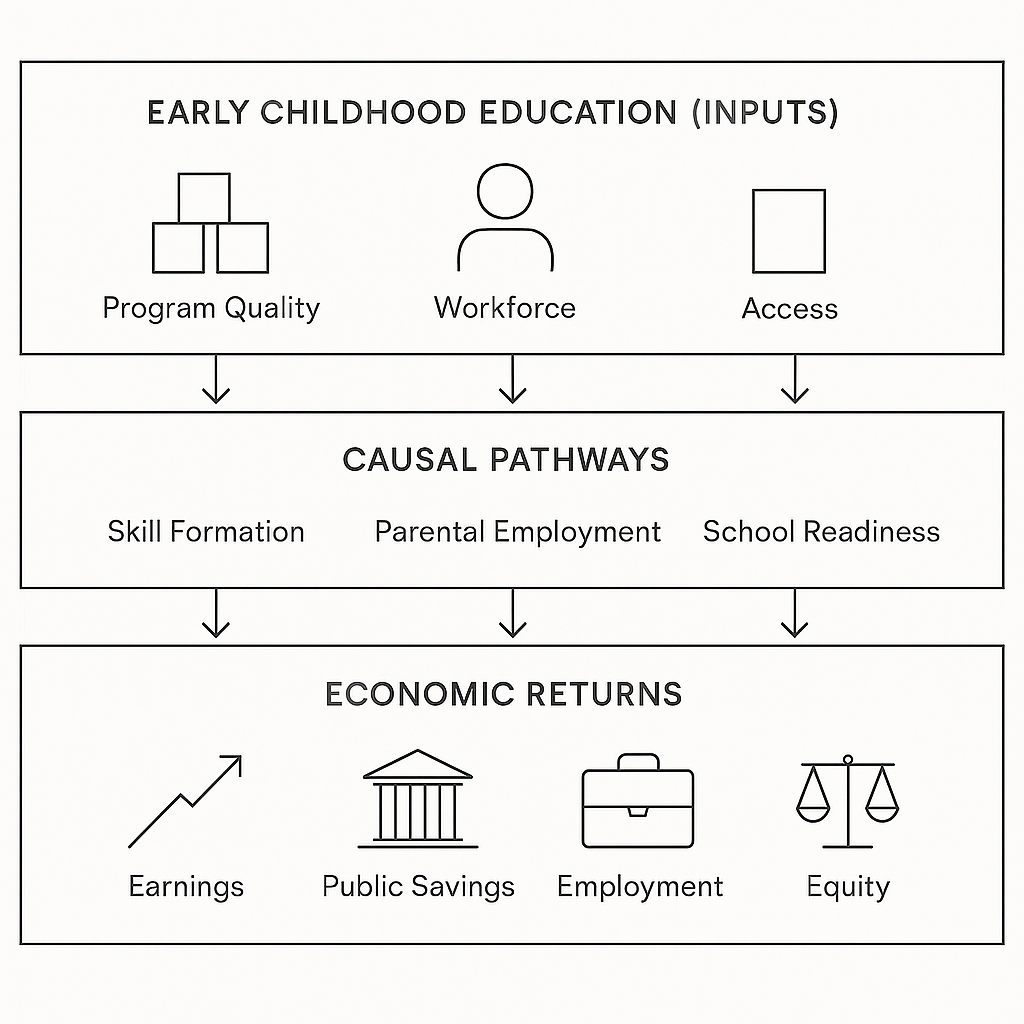
One of the primary mechanisms through which early childhood education generates economic returns is by improving children’s early learning and developmental trajectories. High-quality programs reliably improve school readiness in areas such as language development, early literacy, numeracy, and social-emotional skills. These early advantages are predictive of later academic success, including higher achievement, lower rates of grade retention, and reduced placement in special education (CEA, 2014). From a fiscal perspective, reductions in grade repetition and special education translate into meaningful savings for K–12 education systems, while also improving students’ educational experiences.
Long Term Outcomes
Over time, these early educational gains are associated with higher rates of high school graduation and postsecondary attainment. Evidence from classic randomized interventions such as the Perry Preschool and Abecedarian projects, reinforced by recent re-analyses using modern econometric methods, shows that participants are more likely to complete high school and pursue higher education than comparable peers (Heckman et al., 2016; Baulos et al., 2024). These outcomes matter economically because educational attainment is strongly linked to labor‑market stability and lifetime earnings.
Indeed, increased lifetime earnings constitute one of the largest components of the economic benefits attributed to early childhood education. By enhancing both cognitive and noncognitive skills—such as self-regulation, persistence, and social competence—ECE increases productivity and employability in adulthood. Cost–benefit analyses consistently find that the present value of increased earnings alone can justify a substantial portion of program costs (Heckman et al., 2016). In some cases, researchers also document intergenerational benefits, as higher earnings and educational attainment among participants contribute to more stable family environments for their own children (Baulos et al., 2024).
Family Level Effects
Importantly, the economic effects of early childhood education are not confined to children’s long-term outcomes. Families also experience significant near-term benefits, particularly through increased parental labor force participation. Access to affordable, reliable early education enables parents—especially mothers—to work more hours, enter the labor market, or pursue additional education and training. Recent studies of universal pre-K expansions provide strong evidence of these effects. For example, analyses of New York City’s universal pre-K program show increases in maternal labor force participation of approximately 5 percentage points following implementation (Timilsina, 2025). Broader national studies similarly find that access to free pre-K increases maternal employment, with larger effects in states offering full-day programs (Ilin et al., 2021).

Public Sector Impacts
From the public sector’s perspective, early childhood education also generates substantial savings by reducing downstream expenditures. Lower rates of grade retention and special education reduce educational costs, while long-term follow-ups of intensive early interventions show significant reductions in criminal activity, arrests, and incarceration (CEA, 2014; Baulos et al., 2024). These criminal justice savings often account for a large share of the total economic returns in targeted programs serving disadvantaged children. In addition, improvements in adult health outcomes—documented in both classic and recent studies—can reduce long-term health care spending and reliance on social safety‑net programs (Heckman et al., 2016).
When researchers aggregate these diverse benefits, they commonly summarize returns using metrics such as benefit–cost ratios, internal rates of return, and net present value. Across U.S. studies, benefit–cost ratios typically range from approximately 2:1 to over 10:1, with some targeted programs yielding even higher returns (CEA, 2014; Baulos et al., 2024). While universal programs often produce smaller per-child returns than intensive targeted interventions, recent evidence suggests they can generate substantial aggregate economic benefits due to their scale and immediate labor‑market effects (Jackson et al., 2025).
Beyond individual and fiscal outcomes, early childhood education has important implications for the U.S. economy. By strengthening foundational skills early in life, ECE contributes to long-run productivity growth and economic competitiveness. A more skilled workforce is better positioned to adapt to technological change and support public finances through higher tax contributions. Expanded access to early education also promotes gender equity by reducing childcare constraints that disproportionately limit women’s labor market participation (Bivens et al., 2016; Timilsina, 2025).
Early childhood education also plays a critical role in reducing inequality. Children from low-income families and historically marginalized communities consistently experience the largest gains from high-quality early education. By narrowing gaps in school readiness and early achievement, ECE can mitigate the effects of early disadvantage and reduce disparities in education, income, health, and criminal justice involvement later in life (Moore et al., 2023). In this sense, early childhood education enhances both economic efficiency and equity.
Counterarguments and Limitations
At the same time, the evidence is clear that not all early childhood education yields the same returns. Program quality is the single most important determinant of long-term impact. Well-trained educators, low child–staff ratios, evidence-based curricula, and continuous quality improvement systems are essential for sustaining gains over time (CEA, 2014; Moore et al., 2023). Programs that are under-resourced or poorly implemented may generate smaller or fading effects, underscoring the importance of standards, accountability, and adequate funding.
Despite strong evidence supporting ECE as a high-yield public investment, several counterarguments complicate the claim that expanding ECE will reliably generate large economic returns across all contexts. A central concern is that positive results from small, high–quality model programs may not generalize to large–scale public systems. Much of the most compelling evidence—such as the Perry Preschool and Abecedarian projects—comes from intensive, resource-rich interventions delivered by highly trained staff, with low child–teacher ratios and substantial family engagement. Scaling programs of comparable quality at the state or national level is challenging and costly, raising questions about whether similar outcomes can be achieved in practice (Council of Economic Advisers [CEA], 2014; Heckman et al., 2016).
Relatedly, critics note that impacts on cognitive test scores often fade over time, particularly in large public programs. While long-term outcomes, such as earnings or reduced crime, may still improve, the short-term fadeout of academic gains has fueled skepticism about the effectiveness of preschool investments. This concern is especially prominent in evaluations of broad programs like Head Start, where results on adult earnings and employment are mixed and sometimes statistically insignificant (Deming, 2009; Pages et al., 2020). Such findings suggest that early education alone may be insufficient to overcome later environmental disadvantages without complementary investments in K–12 schooling and family supports.

Another limitation involves heterogeneity in program quality. Evidence consistently shows that low-quality or poorly implemented ECE programs produce much smaller—and sometimes negligible—returns. Expanding access without ensuring strong standards, workforce training, and accountability mechanisms risks diluting program effectiveness. From a fiscal standpoint, this raises the possibility that public funds could be spent on programs that do not generate benefits sufficient to justify their costs, particularly in under-resourced districts (CEA, 2014; Moore et al., 2023).
There are also equity–related concerns about universal versus targeted approaches. While universal pre–K programs can generate aggregate economic benefits and support parental employment, some economists argue that returns are highest for children from disadvantaged backgrounds, suggesting that targeted programs may be more cost‑effective on a per-child basis. Universal programs may allocate substantial resources to families who would otherwise purchase private care, thereby reducing net social gains relative to targeted interventions (Bivens et al., 2016; Jackson et al., 2025).
Finally, critics emphasize opportunity costs and budget constraints. Public investments in early childhood education must be weighed against alternative uses of limited fiscal resources, such as K–12 reform, higher-education affordability, or direct income supports. While ECE yields long-term benefits, many of these returns accrue decades in the future, whereas governments face immediate budget pressures. In periods of fiscal austerity, policymakers may therefore question whether long-run gains sufficiently justify near-term expenditures, particularly when benefits depend heavily on sustained program quality and follow-through (CEA, 2014).
Taken together, these counterarguments do not refute the economic case for early childhood education, but they underscore that returns are contingent rather than automatic. The evidence suggests that early childhood education is a highly productive investment only when programs are well designed, adequately funded, and integrated with broader educational and social policies (Heckman et al., 2016; Moore et al., 2023). Acknowledging these limitations strengthens, rather than weakens, the argument for ECE by clarifying the conditions under which public investments are most likely to succeed.
Conclusions
Taken together, the research leaves little doubt that early childhood education is a high-yield public investment. It improves educational, economic, and health outcomes; increases parental employment; reduces public expenditures; and strengthens the future workforce. Framed this way, early childhood education is not merely social spending. It is a strategic investment in the nation’s economic capacity and long-term well-being. This investment has durable returns that extend far beyond the classroom.
References
Baulos, A. W., García, J. L., & Heckman, J. J. (2024). Perry Preschool at 50: What lessons should be drawn and which criticisms ignored? NBER Working Paper No. 32972. National Bureau of Economic Research.
https://www.nber.org/papers/w32972
Bivens, J., García, E., Gould, E., Weiss, E., & Wilson, V. (2016). It is time for an ambitious national investment in America’s children: Investments in preschool can generate nearly 9 times the return on investment. Economic Policy Institute.
https://www.epi.org/publication/its-time-for-an-ambitious-national-investment-in-americas-children/
Council of Economic Advisers. (2014). The economics of early childhood investments. Executive Office of the President of the United States.
https://obamawhitehouse.archives.gov/sites/default/files/docs/early_childhood_report1.pdf
Deming, D. (2009). Early childhood intervention and life‑cycle skill development: Evidence from Head Start. American Economic Journal: Applied Economics, 1(3), 111–134.
https://doi.org/10.1257/app.1.3.111
Heckman, J. J., García, J. L., & Leaf, D. E. (2016). The lifecycle benefits of an influential early childhood program. Human Capital and Economic Opportunity Working Group Paper. University of Chicago.
https://heckmanequation.org/resource/13-roi-toolbox/
Ilin, E., Shampine, S., & Terry, E. (2021). Does access to free pre‑kindergarten increase maternal labor supply? Federal Reserve Bank of Kansas City Research Working Paper 21‑11.
https://www.kansascityfed.org/documents/8503/rwp21-11ilinshampineterry.pdf
Jackson, C. K., Turner, J., & Bastian, J. (2025). Universal pre‑K as economic stimulus: Evidence from nine states and large cities in the U.S. Institute for Policy Research Working Paper 25‑25. Northwestern University.
https://www.ipr.northwestern.edu/documents/working-papers/2025/wp-25-25.pdf
Moore, R., Poole, C., & Hanna, H. (2025). Investing in early childhood education pays dividends. Social Sciences Review, 12(3), 1–25.
Pages, R. J.‑C., Lukes, D. J., Bailey, D. H., & Duncan, G. J. (2020). Elusive longer‑run impacts of Head Start: Replications within and across cohorts. Educational Evaluation and Policy Analysis, 42(4), 471–492.
https://doi.org/10.3102/0162373720948884
Timilsina, L. (2025). Kids to school and moms to work: New York City’s universal pre–K expansion and mothers’ employment (CES Working Paper No. 25‑62). U.S. Census Bureau.
https://www2.census.gov/library/working-papers/2025/adrm/ces/CES-WP-25-62.pdf
 Modern Media Barn