A Comprehensive Analysis of Budgetary, Regulatory, and Distributional Change
Executive Summary
The period spanning 2025 through early 2026 marked a significant effort to retrench the federal role in education through proposed budget reductions, program consolidations, and administrative restructuring at the U.S. Department of Education (USED). Repeated proposals sought to reduce the department’s budget by approximately $12 billion, eliminate or consolidate long-standing categorical programs, and shift greater responsibility to states. At the same time, major regulatory changes were undertaken to implement the One Big Beautiful Bill Act (OBBB). Although many of the most severe funding reductions were not enacted due to congressional resistance and the passage of the Consolidated Appropriations Act, 2026, the sustained pursuit of retrenchment created substantial uncertainty across K–12 and higher education systems. Proposed changes threatened access and support for low-income students, English learners, migrant students, rural districts, and institutions serving high-need populations, with disproportionate effects on states that rely heavily on federal education funding. Overall, the experience of 2025–2026 underscores the central role of federal investment in maintaining equity, access, and stability in the U.S. education system and highlights the risks of devolving responsibility without providing commensurate financial resources.

Introduction
It has been approximately 1 year since major changes began at the US Department of Education (USED), so it is a good time to look back at what has happened. The period spanning 2025 through early 2026 marked one of the most consequential attempts in decades to restructure the USED. Federal policymakers advanced sweeping proposals to reduce the agency’s discretionary authority, consolidate or eliminate long-standing programs, and shift responsibility for core educational functions to states. These efforts unfolded alongside major regulatory initiatives required by the One Big Beautiful Bill Act (OBBB), which had rewritten the statutory framework for Title IV student aid. The result was a complex policy environment in which aggressive budgetary retrenchment, administrative restructuring, and political conflict converged. This report synthesizes those developments into a unified analysis of the federal education landscape, drawing on the documented actions, proposals, and consequences described in the source material.
The Budget Environment of 2025 and the Emergence of a Retrenchment Agenda
The 2025 budget cycle opened with a clear and coordinated effort by the White House and House Republicans to reduce the federal role in education. The administration’s May 2025 “skinny budget” proposed cutting USED funding from $78.7 billion to $66.7 billion, a reduction of approximately $12 billion, or 15.3 percent (U.S. Department of Education, 2026). The document notes that these reductions were applied “line item after line item,” reflecting an explicit goal of shrinking or dismantling the department. A similar $12 billion reduction appeared in the FY2026 proposal released later in 2025, which reiterated the administration’s intention to “wind down” the agency (Federal Register, 2026). These proposals were not isolated events but part of a sustained ideological commitment to reducing federal oversight and shifting authority to states.
Congressional Republicans advanced parallel proposals. The House FY2025 appropriations plan recommended reducing USED from $79 billion to $67 billion, again a $12 billion cut, while targeting Federal Work‑Study, English learner programs, and other categorical grants (NASFAA, 2025). Senate appropriators resisted the most extreme reductions, creating a year defined by competing budget visions and legislative stalemate. Although Congress ultimately preserved most USED funding through September 2026 via the Consolidated Appropriations Act (H.R. 7148), the persistence of these proposals signaled a profound shift in federal priorities (Congress.gov, 2026).
Alternative Arguments and Policy Rationales
Proponents of federal education retrenchment advanced several alternative arguments to justify proposed budget reductions, program consolidations, and regulatory restructuring during the 2025–2026 period. Central among these arguments was the claim that the federal role in education had expanded beyond its intended scope and that greater efficiency could be achieved by devolving authority to states and local governments. Supporters of retrenchment contended that categorical federal programs were overly prescriptive, administratively burdensome, and insufficiently responsive to local conditions, particularly in diverse K–12 systems (U.S. Department of Education [USED], 2026).
A second argument emphasized fiscal responsibility and long-term budget sustainability. Advocates of reduced federal education spending argued that slowing the growth of discretionary programs was necessary to address broader federal deficit concerns. From this perspective, consolidating programs and reducing overall appropriations were framed as prudent steps to control spending while preserving core functions such as special education and baseline student aid (Congress.gov, 2026). Proponents further suggested that temporary funding instability was an unavoidable consequence of necessary structural reform rather than an indication of permanent withdrawal.
Supporters of block grant consolidation also argued that increased state flexibility would lead to more effective and innovative educational interventions. By combining multiple targeted programs into a single funding stream, states would be better positioned to allocate resources according to locally identified priorities rather than federally determined categories. This approach was presented as a means to reduce compliance costs, eliminate duplicative programs, and encourage experimentation in program design, particularly in rural and low-capacity districts (USED, 2026).
In higher education, advocates for restructuring federal student aid programs argued that campus-based aid and supplemental grant programs had become inefficient and unevenly distributed across institutions. From this perspective, reducing or eliminating programs such as Federal Work‑Study and FSEOG was framed as a reallocation rather than a reduction of support, with greater emphasis placed on simplifying the student aid system and relying on formula-based or entitlement programs to deliver assistance more uniformly (National Association of Student Financial Aid Administrators [NASFAA], 2025).
Finally, proponents of retrenchment asserted that many proposed reductions were intended to prompt institutional adaptation rather than eliminate services outright. Colleges, school districts, and states were expected to adjust through alternative funding mechanisms, private partnerships, or internal reallocation of resources. Under this view, federal retrenchment was positioned as a catalyst for modernization and efficiency rather than a retreat from educational equity or access (Federal Register, 2026).
Regulatory Transformation and Administrative Actions in Early 2026
While budget negotiations continued, USED moved into an intensive regulatory phase required by the OBBB. The department issued a Notice of Proposed Rulemaking to align Title IV regulations with new statutory caps, repayment structures, and accountability measures (Federal Register, 2026). The brief notes that USED simultaneously announced a temporary pause on involuntary collections for defaulted federal student loans, including wage garnishment and Treasury offsets, to avoid enforcing outdated rules during the transition to a new repayment system. These actions marked a shift from legislative uncertainty to administrative restructuring, even as the agency faced the possibility of deep budget cuts.
Programmatic Consequences Across K–12 and Higher Education
The proposed reductions carried significant implications for both K–12 and higher education. In higher education, the administration sought to eliminate the Federal Supplemental Educational Opportunity Grant (FSEOG), a $910 million program serving low-income students, and to reduce Federal Work‑Study by amounts ranging from $451 million in the House plan to $980 million in the administration’s proposal (NASFAA, 2025). The brief documents that reductions to Pell-adjacent supports, federal research funding, and campus-based services intensified financial pressures on public colleges already grappling with rising tuition and declining enrollment.
K–12 programs faced even more dramatic restructuring. The administration proposed consolidating eighteen targeted funding streams—including rural education, civics education, homeless youth programs, and English learner support—into a single $2 billion block grant, down from $6.5 billion. This consolidation represented not only a substantial funding reduction but also a philosophical shift away from federal guarantees for vulnerable populations. Some proposals would have eliminated all $1.3 billion in support for English learners and migrant students. In comparison, others would have reduced Title I by $4.7 billion, the nation’s primary support for low-income schools. The brief notes that these proposals “would have collapsed 18 funding streams, reducing them from $6.5B to $2B,” a change that would have fundamentally altered the federal commitment to educational equity.
Special education services under IDEA were not directly cut, but the broader reductions exacerbated existing funding gaps. Districts faced rising caseloads, staffing shortages, and increased difficulty meeting federal mandates. K–12 systems also experienced staffing reductions, loss of enrichment programs, and tighter resource availability for core instructional needs. These pressures were particularly acute in high-poverty and rural districts that rely heavily on federal support.

Groups & School Programs Most Affected by 2025 ED Cuts
| Group / Program | Impact of Cuts |
| Title I / Low‑Income K–12 Schools | Deep proposed cuts; FY26 proposals (released in 2025) included a $4.7B reduction for schools in low‑income communities. |
| English Learners & Migrant Students | Proposed elimination of all $1.3B supporting English language learners and migrant students. |
| Federal Work‑Study (FWS) | Trump proposed a $980M cut; House Republicans proposed a $451M cut. |
| Targeted K–12 Support Programs (18 Funding Streams) | Proposed consolidation of 18 programs, cutting funding from $6.5B to $2B (e.g., rural schools, civics, homeless youth, after‑school programs). |
| Special Education (IDEA) | Not directly cut, but broader ED reductions worsened staffing shortages and expanded caseloads. |
| Low‑Income College Students / Higher Ed Funding | Pell‑adjacent support, research funding, and campus‑based services reduced; tuition pressures increased. |
| K–12 Student Support Services | Cuts led to fewer staff, loss of enrichment programs, and reduced resources for instructional needs. |
What Was Proposed Versus What Was Enacted
Although the proposals were sweeping, the brief emphasizes that many of the most dramatic cuts remained unimplemented due to Senate resistance and political gridlock. Congress’s enactment of the Consolidated Appropriations Act, 2026, preserved most USED programs through September 2026, delaying the realization of the proposed $12 billion in cuts (Congress.gov, 2026). Nevertheless, the repeated appearance of the same $12 billion reduction across multiple proposals underscored the administration’s sustained commitment to shrinking the department. The year 2025 was therefore defined more by aggressive proposals than by fully realized reductions, but the cumulative effect of these proposals created significant instability across the education sector.
Distributional Effects and the Uneven Geography of Loss
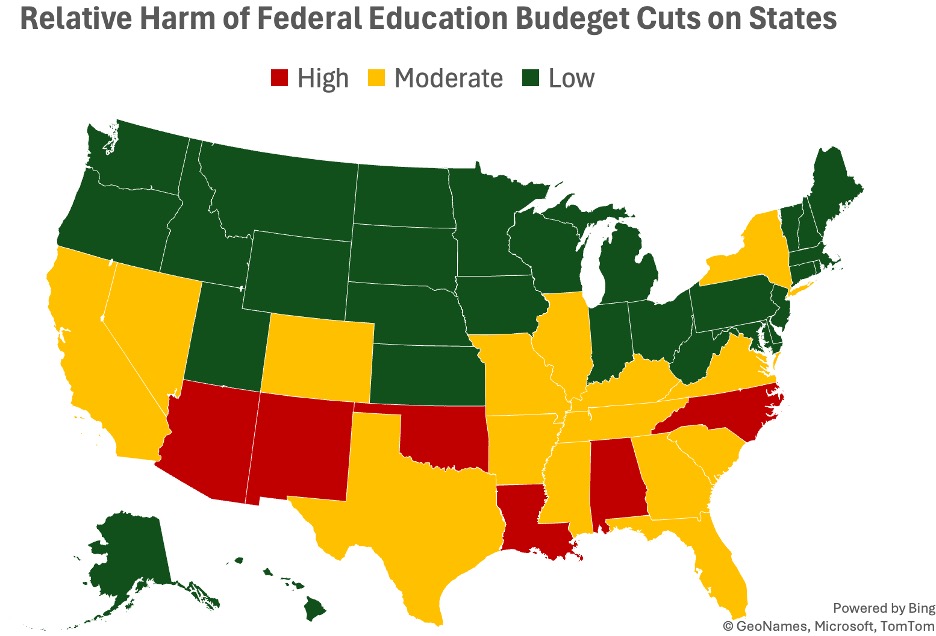
The consequences of the proposed cuts were not evenly distributed across states. The brief documents that states with high federal funding dependence—such as Arizona, Oklahoma, New Mexico, and North Carolina—were disproportionately harmed because federal dollars constitute a larger share of their K–12 budgets. High-poverty states, including Louisiana and Alabama, faced compounded losses due to the concentration of Title I‑eligible districts. The July 2025 freeze of $6.8 billion in federal K–12 funds intensified these disparities, placing states with large populations of English learners, migrant students, and low-income families in what officials described as “triage mode.”
States with limited local revenue capacity were unable to backfill federal losses, leaving districts without viable alternatives. The brief notes that states with large high-need populations—including rural students, English learners, and students requiring special education—were the most vulnerable to both proposed cuts and administrative freezes. These patterns created a geographic concentration of harm in the Southwest and Deep South, where poverty rates, EL populations, and dependence on federal funding intersect.
Illustrative Map of Federal Money Lost
The map is a qualitative impact map, not a dollar-by-dollar allocation. States were categorized as High, Moderate, or Low impact based on a synthesis of reported evidence from the 2025 federal education funding freezes and proposed cuts. The primary criteria included (1)state reliance on federal K–12 funding, (2)concentration of child poverty, (3)shares of English learner and migrant students, and (4)contemporary reporting and advocacy sources that explicitly identified states experiencing disruption. Because no audited state-level loss data were available, the map reflects relative vulnerability and reported disruption, rather than precise financial losses, and it acknowledges significant variation within states.
State Gains: Authority Without Resources
Although the administration framed the proposed cuts as a way to empower states, the brief makes clear that states gained authority but not funding. Consolidation of federal programs into state-directed block grants increased state discretion but reduced total resources. The administration’s stated goal of “returning responsibility to the states” did not include transferring federal savings to state budgets. Instead, states assumed greater responsibility for program design, accountability, and oversight, but lacked the financial support needed to sustain services. The brief concludes that states became more financially vulnerable, not less, as they faced reduced federal aid, rising costs, and increased administrative burdens.
Conclusion
The 2025–2026 period represents a pivotal moment in federal education policy. While many proposed cuts were not enacted, the sustained effort to reduce USED’s budget by approximately $12 billion signaled a profound shift in federal priorities. The proposed elimination of targeted programs, consolidation of funding streams, and reduction of campus-based aid threatened the stability of services for low-income students, English learners, migrant families, rural communities, and students with disabilities. States gained flexibility but not resources, and those with the greatest need faced the greatest harm. As Congress continues to negotiate future budgets, the lessons of 2025 underscore the importance of maintaining federal commitments to equity, access, and support for the nation’s most vulnerable learners.
References
Congress.gov. (2026). Consolidated Appropriations Act, 2026 (H.R. 7148).
Federal Register. (2026). Reimagining and Improving Student Education: Notice of Proposed Rulemaking.
Inside Higher Ed. (2025). Coverage of federal education budget proposals and institutional impacts.
National Association of Student Financial Aid Administrators. (2025). Analysis of federal student aid proposals and campus–based program reductions.
U.S. Department of Education. (2026). Administrative actions on student loan collections and Title IV regulatory updates.
 Modern Media Barn