I’ve seen complexity used to silence criticism. Reciprocal tariff calculations look thorough and scientific because most people aren’t familiar with equations or Greek letters. But when examined closely, it’s much more straightforward. While an overly complex equation may be the result of a rushed simplification process, the result is misleading to many readers.
https://ustr.gov/issue-areas/reciprocal-tariff-calculations
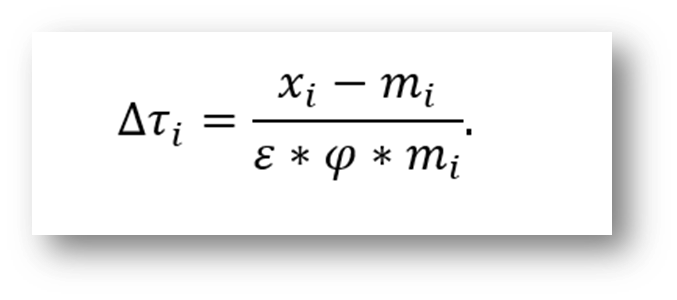
Across the equation, slightly lower (subscript) I (iota) is not necessary but refers to calculations by country. If you remember that calculations are on the country level, you can safely ignore these.
First, you see the triangle (delta) T (Tau). The delta is typically used to indicate change. It is basically meaningless in this context.
The core of the equation is the X (Chi) and M (Mu), which represent the country’s exports to the US and imports from the US. More on this soon.
The calculation includes two constants, which are values that remain the same across all calculations. These constants represent different measures of elasticity of demand. Elasticity refers to the idea that people’s purchasing habits will shift in response to changes in price.
There are two issues with the concepts of elasticity. First, elasticity varies depending on the product. For example, if the price of essential medication increases, consumers are more likely to continue purchasing it. In contrast, if the price of eggs rises, they might look for a substitute. Additionally, elasticity differs by the source country; US consumers may be more willing to accept a higher price for Canadian lumber than for products from TEMU. Using a single set of elasticity measures for the entire world is an oversimplification.
The second issue with elasticity is measured, rendering both useless. The E (lowercase Epsilon) represents import elasticity and is set at 4. The lower-case Phi is used to represent export elasticity and is set at 0.25. When you multiply 4 times 0.25 (1/4), the product is equal to one and can be safely omitted from the equation. In addition, the multiplication symbols (*) are usually omitted in such equations.
When simplified, the calculation for a country’s tariff on US goods is:
Tariff = (Exports – Imports)/Imports.
The administration did not attempt to measure tariff rates for each country; instead, it assumed that a trade deficit (exports minus imports) was solely the result of tariffs imposed by other nations. They are using the trade deficit as a proxy for actual measurement. While this proxy measurement is often employed when reliable data cannot be obtained, it is not the preferred method.
 Modern Media Barn